
Stained Glass of Percy Bacon & Brothers
- Home
- Life
- UK County List
- Bedfordshire
- Berkshire
- Bristol
- Buckinghamshire
- Cambridgeshire
- Cornwall
- Cumbria
- Derbyshire
- Devon
- Dorset
- Dumfries & Galloway
- Durham
- East Sussex
- Essex
- Gloucestershire
- Gtr Manchester
- Hampshire
- Herefordshire
- Hertfordshire
- Kent
- Leicestershire
- Lincolnshire
- Gtr London
- Barnes:
St Michael - Camden:
St James † - City: St Dunstan-in-the-West
- Clapton,
Christ Church† - Croydon: Woodcote
- Ealing:
Christ Church† - Ealing: St Saviour†
- Hammersmith
St Paul - Hornchurch
- Little Ilford
- Islington, St Paul†
- Kensington:
St John the Baptist - Mortlake:
St Mary Mag, RC - Perry Hill,
St George† - Roehampton
- Romford, St Edward the Confessor
- Twickenham,
St Stephen - Upminster,
St Laurence - Upton Cross,
St Peter† - Woolwich Garrison†
- Woolwich:
St Michael - Yiewsley
- Barnes:
- Midlothian
- Merseyside
- Norfolk
- North Yorkshire
- Northamptonshire
- Northern Ireland
- Northumberland
- Nottinghamshire
- Oxfordshire
- Pembrokeshire
- Rutland
- South Yorkshire
- Somerset
- Suffolk
- Surrey
- Tyne & Wear
- Warwickshire
- West Sussex
- Wiltshire
- Worcestershire
- Non UK
- Gazetteer
- Contact
- Essays
- Lost Work
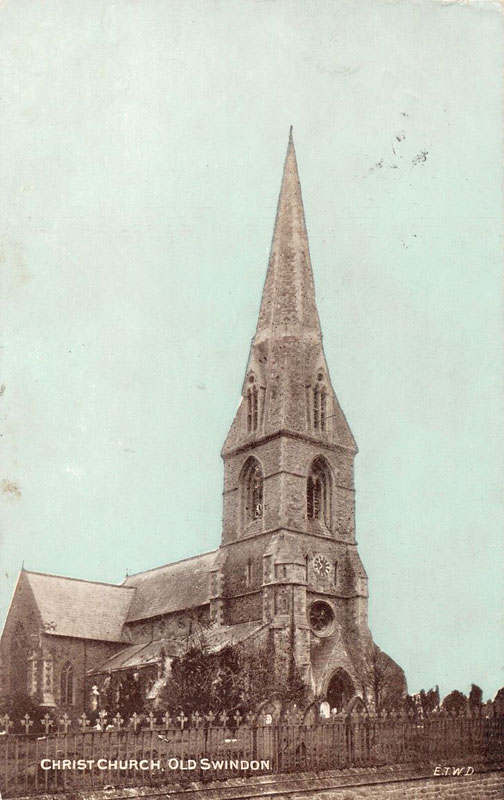
Christ Church Old Swindon, c1905
The Devizes and Wiltshire Gazette of Thursday 13th November 18511 printed a report on the consecration ceremony held on the previous Friday. A transcript of the introduction is reproduced here.
CONSECRATION OF THE NEW CHURCH SWINDON. The dedication of new and beautiful edifice to God's honour and glory is, under any circumstances, a matter of touching interest ; but when we find that that edifice has been raised by the hearty voluntary contributions of those who regard the Church of England the only rock, “amidst the ever-varying tides and currents of a restless age," upon which they may that their feet are safely placed, the circumstance becomes one peculiar gratification ; because it reassures us that whatever may be the small divisions which here and there disturb her unity, the Church is still sound at the core, and her embers as ready as ever to make the House God worthy of those beautiful devotional services which have for so many ages formed her best bulwark against the assaults that have been made against her. It may be interesting perhaps to some our readers who are not already acquainted with the circumstances which have led to the erection of the handsome edifice which shall presently endeavour to describe, if we briefly recapitulate a few facts connected with it, which have former occasion appeared in our paper. Those who are acquainted with Swindon need scarcely be told, that since the formation of the Great Western Railway, a gradual increase has been taking place in the population of the Old Town; until of late years this increase has become so great, as to render the parish church [Holy Rood] altogether incapable affording accommodation to the resident members of her communion. It was in the year 1847 that the new incumbent, the Rev. H. G. Baily, deeply sensible of this deficiency, first directed the attention of his parishioners to the consideration of some means by which additional accommodation might be procured. Vestries were held to take the serious subject into consideration, and a committee was appointed to procure plans and estimates for altering and enlarging the old church; but it was found that the ancient edifice was so inconveniently constructed, that any attempt to alter its present arrangement, so to meet the requirements of the parish, would fail. It was then that Mr. A L. Goddard handsomely came forward and offered to contribute £1000 towards building a new church; his father also offering a site for it and for the burial ground.2 The parishioners were not slow in adopting the suggestion.
A design for new church was speedily obtained from Mr. Gilbert Scott, the eminent architect, and a resolution was carried in vestry to raise the necessary funds above the £1000 on the credit of the church rates. This mode of raising the money was, however, afterwards defeated by opposition, which many of our readers will remember. But the zealous and indefatigable Vicar was not to be deterred from a work which he so much at heart, and with a zeal worthy of the cause the rev. gentleman at once applied himself to an endeavour to obtain the necessary funds by voluntary contributions, and backed the praiseworthy exertions of the principal inhabitants, and by a hearty unity of purpose on the part of his parishioners generally, he so far succeeded in his endeavours, that in the June of last year, the first stone was laid of the New Church which was today the object of so much interest. We believe, however, that small part has attended the undertaking, upon the accomplishment which the Vicar has shown himself of latent, may be attributed to the hearty exertions which have been devoted by his Churchwardens—Mr. Bradford and Mr. hare, supported the rev. gentleman through difficulties and liabilities few would willingly have encountered. As regards Mr. Bradford, not only has that gentleman come forward in the most handsome manner in a pecuniary point of view, but nothing which time or trouble could effect, has he left undone in endeavouring to further the work. Praise, we are well aware, has not been his object; but we are sure the parishioners Swindon would feel that had but ill discharged our office attempting to give a report of the proceedings of the day, and the circumstances which have led to them, were to omit this allusion to the indefatigable and liberal part which Mr. Bradford has taken in helping forward work which may not only make them justly proud of the town in which they live, but which will hereafter supply them with the means of participating in the ordinances of our Church, of which many of them, hitherto, have been unfortunately deprived.
With these few introductory remarks, we will now endeavour lay before our readers a description the Church, and the proceedings connected with its consecration. The building itself, which is good specimen of the ecclesiastical architecture Mr. Gilbert Scott, is in the early English decorated style, being that which was prevalent in this country at the commencement of the fourteenth century. Its elevated situation at the north entrance to the town (immediately facing the Great Western Railway) gives it a most picturesque effect: and its lofty spire, rising behind the row of graceful elms which bound the burial ground is seen for many miles around. The dimensions of the interior are, we believe, about hundred and eighteen feet in length, by fifty in breadth, exclusive of the transepts. It consists of nave, with north and south aisles, and an elegant chancel, resting on pendants of small clustered columns, the capitals being finely carved in exceedingly bold foliage of oak leaves and acorns. On either side of the chancel is a chapel, the corbels of the arches of which present the symbols of the evangelists: indeed, the carved work throughout merits special commendation. The clerestory windows of the nave are of somewhat novel design, and being varied in form, produce pleasing effect. Immediately the western entrance stands a beautiful font, made of Caen stone (the gift of Miss M. Jenner of Walcot). The pulpit, which is also made of the same material, finely carved, rests against the last pillar on the north side; the lectern, of carved oak, occupying a similar position on the south. The organ, which is placed in the northern chapel, is splendid toned instrument: it was purchased of the celebrated makers, Messrs. Gray and Davison, at a cost of £400 (£200 of which, we are sorry to hear, yet remains to be supplied). Among the various gifts from private individuals, is a rich crimson velvet communion cloth, handsomely worked in gold, the present of Miss L’inchin of Ilatt House (cousin of the Vicar). The carpet around the communion -table, which is all made of needle-work, was given by Miss Clarke, of Ashby, Lincolnshire; and a handsome Bible and Prayer Book by Mrs. Jenner. The whole of the sittings, which are open, are substantially constructed of oak; they are 926 in number: 386 only being appropriated. The church is warmed by heated air, and so far the plan has yet been tested, answers admirably: it has been carried out by Messrs. Nelson and Haden of Trowbridge. The entire cost of the building is something over £7000, of which about £600 have yet to be raised.
References: Use your browser's Back button to return to text.
- Devizes and Wiltshire Gazette, 13 November 1851.
- Richard Jefferries in his book; Jefferies' land, a history of Swindon and its environs published in 1896 suggests that the the Diocesan Society of that day refused any grant because the living was not in the patronage of the bishop, and the Incorporated Church Building Society were only able to give £130. He goes on to report that the stone of the old church of Holyrood was sold off to assist the new church fund, and that the bells - aside from the tenor which was cracked and had to be re-cast - were transferred. Only the chancel of the old church was preserved.
Location Map:
Sat Nav Post Code: SN1 3HG