
Stained Glass of Percy Bacon & Brothers
- Home
- Life
- UK County List
- Bedfordshire
- Berkshire
- Bristol
- Buckinghamshire
- Cambridgeshire
- Cornwall
- Cumbria
- Derbyshire
- Devon
- Dorset
- Dumfries & Galloway
- Durham
- East Sussex
- Essex
- Gloucestershire
- Gtr Manchester
- Hampshire
- Herefordshire
- Hertfordshire
- Kent
- Leicestershire
- Lincolnshire
- Gtr London
- Barnes:
St Michael - Camden:
St James † - City: St Dunstan-in-the-West
- Clapton,
Christ Church† - Croydon: Woodcote
- Ealing:
Christ Church† - Ealing: St Saviour†
- Hammersmith
St Paul - Hornchurch
- Little Ilford
- Islington, St Paul†
- Kensington:
St John the Baptist - Mortlake:
St Mary Mag, RC - Perry Hill,
St George† - Roehampton
- Romford, St Edward the Confessor
- Twickenham,
St Stephen - Upminster,
St Laurence - Upton Cross,
St Peter† - Woolwich Garrison†
- Woolwich:
St Michael - Yiewsley
- Barnes:
- Midlothian
- Merseyside
- Norfolk
- North Yorkshire
- Northamptonshire
- Northern Ireland
- Northumberland
- Nottinghamshire
- Oxfordshire
- Pembrokeshire
- Rutland
- South Yorkshire
- Somerset
- Suffolk
- Surrey
- Tyne & Wear
- Warwickshire
- West Sussex
- Wiltshire
- Worcestershire
- Non UK
- Gazetteer
- Contact
- Essays
- Lost Work


Posted 08 July 2025.
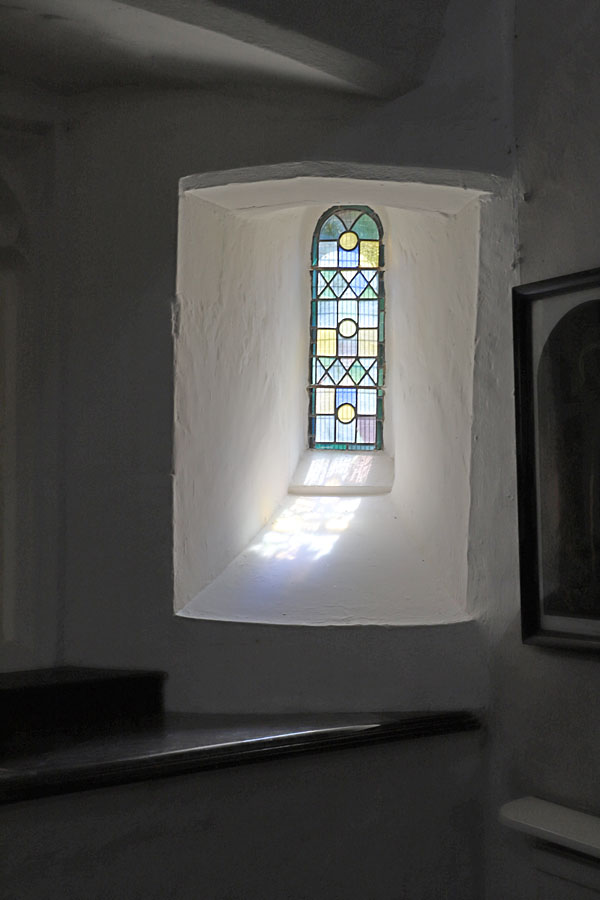
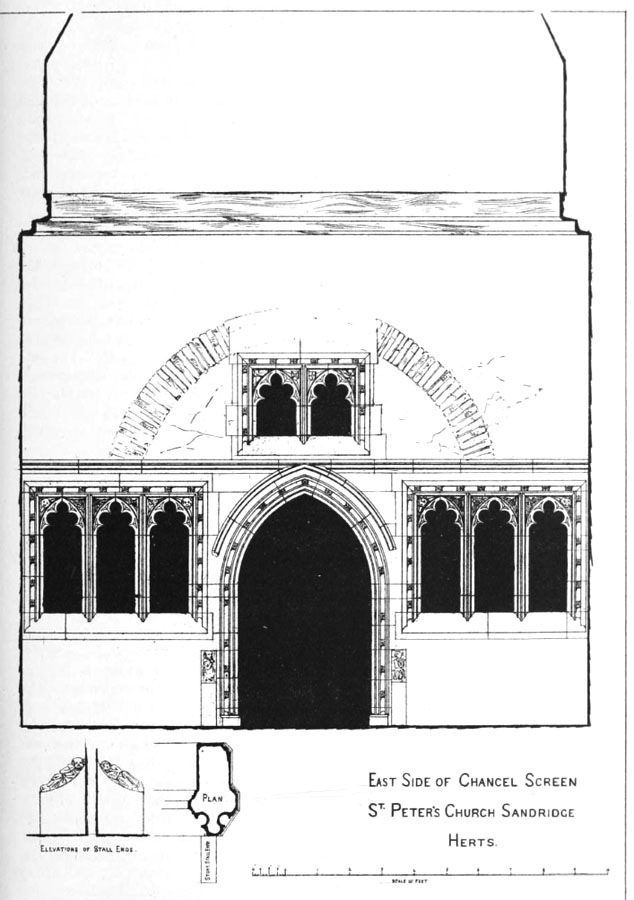
Externally, apart from the curious window shoe-horned into the fabric of the building at the junction of the chancel and east end of the south aisle, St Leonard's is unremarkable. Internally it is the late 14th century stone chancel screen which catches the eye. This curious structure with its thick walls, wide central door and pair of triplet ogee headed lancets either side is said to be unique in Hertfordshire. Above the doorway are another pair of lights, shorter but as well crafted. These are surmounted with a blind arch constructed from Roman bricks. This brickwork was plastered over until a little before 1845.1 Above this arch there is an elaborate heavy traceried wooden screen which reaches to the roof. The latter is modern. Originally the wall above was filled in to the roof, as can be seen in this
drawing of c1880
Drawing of c1880 showing the bench ends and the wall above the chancel door filled in. This was opened up in the restoration of 1887. The brick arch at this time was plastered over, but was opened up sometime before 1845. PD Image
 ,2
and this one from 1845.3
Drawing of the chancel screen of 1845 by Somers Clarke F.S.A. PD Image
,2
and this one from 1845.3
Drawing of the chancel screen of 1845 by Somers Clarke F.S.A. PD Image
However, by the early 20th century the wall above had been removed and the wooden tracery installed, as is evidenced by
this photo published in 1911
Photograph of c1911. By this year the wall above the 14th century stone screen had been removed and wooden tracery installed. PD Image
.4 At this time the clerestory we see today had not been installed, the nave roof resting on the aisle arches, and the chancel's roof ridge was considerably higher than the nave's. Just inside the doorway to the chancel there are two
curious recumbent figures
Carved into the stone bench ends inside the chancel are two curious figures possibly representing confessor and penitent.
Sketch by J. Lewis André from The Reliquary, Vol 24, January 1884. PD Image
carved into stone bench-ends. These seem to depict, on the south side, a bearded monk or friar, and on the north side a woman. There is some speculation that these figures are confessor and penitent. The church was heavily restored by William White in 1886-7.



The curious window mentioned above is installed at an angle of 45 degree, and has a wide internal splay which opens into the nave. Quite what this window was for is a mystery, but it was clearly meant for someone to be able to look into or out of the church. But at what? One suggestion was that it was intended for people outside to look onto an accessory altar in the south east of the nave.5 Alternatively it may have been installed to facilitate communication from the outside in, or vice-versa. It appears from a photograph on the Hertfordshire Genealogy website6 that this aperture was blocked up prior to the 1887 restoration - Somers Clarke makes no mention of it in his 1845 article. Externally the window (as we see it today) appears to be a little too high to qualify as a low side window, however, the ground level was significantly higher in the past as can be seen in another image on the Hertfordshire Genealogy website (the churchyard was levelled in 1888)7. See article on Low Side Windows in Pre-reformation churches, accessed via the Essays menu above.
Download a pdf transcript of a comprehensive description of the chancel screen by Somers Clarke F.S.A. here.


SC1: Scenes following the resurrection of Jesus:
Left: Appearance to the disciples, and doubting Thomas.
Right: Appearance to Mary Magdalene.
South Chancel 1: Scenes following the resurrection of Jesus. c1899.
Posted 08 July 2025.
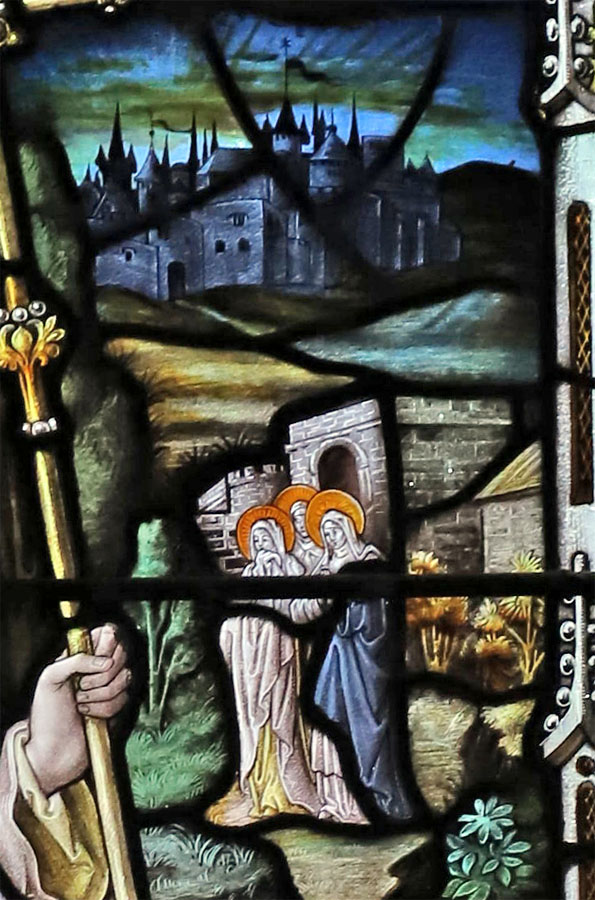
There is a single Percy Bacon and Brothers window in St Leonard's, south chancel 1. This represents two scenes following the resurrection of Jesus:
- Appearance to the disciples, and Doubting Thomas.
- Appearance to Mary Magdalene.
This appearance to Mary Magdalene at the empty tomb is only related in the Gospel of John 20:16-17. In the background of this scene three women can be seen approaching from the city, one of whom carries an urn. These appear to be drawn from the story related in Mark 16, who describes Mary Magdalene, Mary the Mother of James, and Salome going to the tomb to anoint Jesus's body. This conflation of two of the contradictory stories of the days following the crucifixion of Jesus and the visits to the empty tomb was used by Percy Bacon in his 1904 work at Holy Trinity, Westbury-on-Trym.
At the top of the lights angels play harps. The dedication reads:
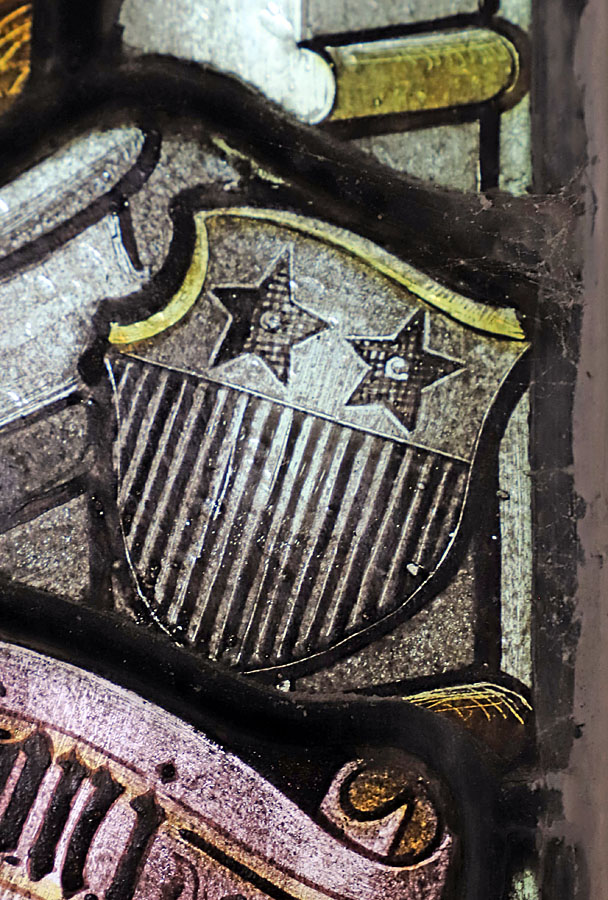
As no specific reference date for the installation of this window has yet been uncovered, it is not exactly clear when this window was installed, but an article in the Herts Advertiser of July 1899 reported that it was in situ at that date.8 Thomas Powney Marten, J.P. died in January 1889. He is buried at Sandridge church.9 He appears to have outlived his wife who died in 1881.10
References: Use your browser's Back button to return to text.
- Clarke, Somers: Sandridge Church, Hertofordshire. Archaeological Journal, Vol 42, 1845 p247 etc.
- Historic England Official List Entry for St Leonard's Sandridge. See also Hertfordshire Genealogy website. This has a photo of the interior showing that the Romas brick arch was plastered over prior to the 1887 restoration.
- Clarke, Somers: Sandridge Church, Hertofordshire. Archaeological Journal, Vol 42, 1845 p249.
- An inventory of the historical monuments in Hertfordshire. NH Stationery Office, 1911, p199.
- Article reporting on the visit to Sandrisge by the St Alban's Archaeological Society: Herts Advertiser - Saturday 01 July 1899, p3. This article mentions the window dedicated to the memory of Mr & Mrs Marten which dates the window to before July 1899.
- The Hertfordshire Genealogy website has an excellent illustrated history of St Leonard's.
- Kelly's Directory, 1888. Description of Sandridge Church.
- Herts Advertiser - Saturday 01 July 1899, p3.
- Hertford Mercury and Reformer - Saturday 19 January 1889, p3.
- Family Search.
Location Map:
Sat Nav Post Code: AL4 9DL