
Stained Glass of Percy Bacon & Brothers
- Home
- Life
- UK County List
- Bedfordshire
- Berkshire
- Bristol
- Buckinghamshire
- Cambridgeshire
- Cornwall
- Cumbria
- Derbyshire
- Devon
- Dorset
- Dumfries & Galloway
- Durham
- East Sussex
- Essex
- Gloucestershire
- Gtr Manchester
- Hampshire
- Herefordshire
- Hertfordshire
- Kent
- Leicestershire
- Lincolnshire
- Gtr London
- Barnes:
St Michael - Camden:
St James † - City: St Dunstan-in-the-West
- Clapton,
Christ Church† - Croydon: Woodcote
- Ealing:
Christ Church† - Ealing: St Saviour†
- Hammersmith
St Paul - Hornchurch
- Little Ilford
- Islington, St Paul†
- Kensington:
St John the Baptist - Mortlake:
St Mary Mag, RC - Perry Hill,
St George† - Roehampton
- Romford, St Edward the Confessor
- Twickenham,
St Stephen - Upminster,
St Laurence - Upton Cross,
St Peter† - Woolwich Garrison†
- Woolwich:
St Michael - Yiewsley
- Barnes:
- Midlothian
- Merseyside
- Norfolk
- North Yorkshire
- Northamptonshire
- Northern Ireland
- Northumberland
- Nottinghamshire
- Oxfordshire
- Pembrokeshire
- Rutland
- South Yorkshire
- Somerset
- Suffolk
- Surrey
- Tyne & Wear
- Warwickshire
- West Sussex
- Wiltshire
- Worcestershire
- Non UK
- Gazetteer
- Contact
- Essays
- Lost Work

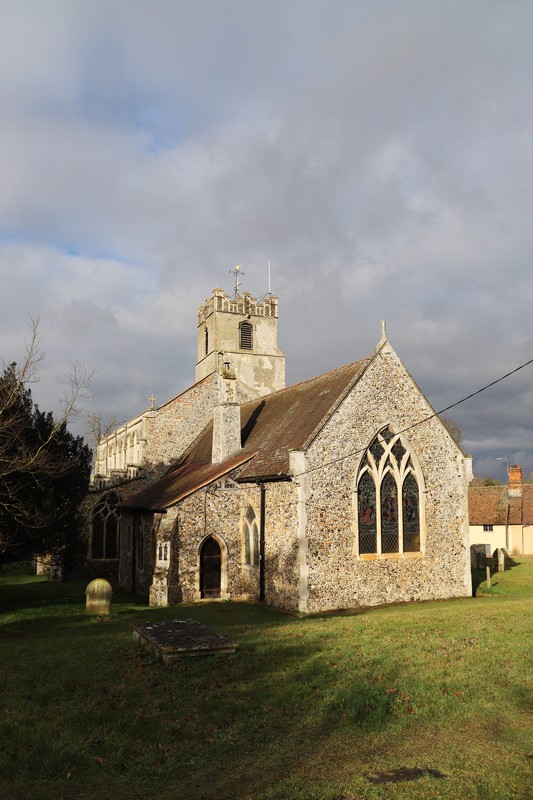
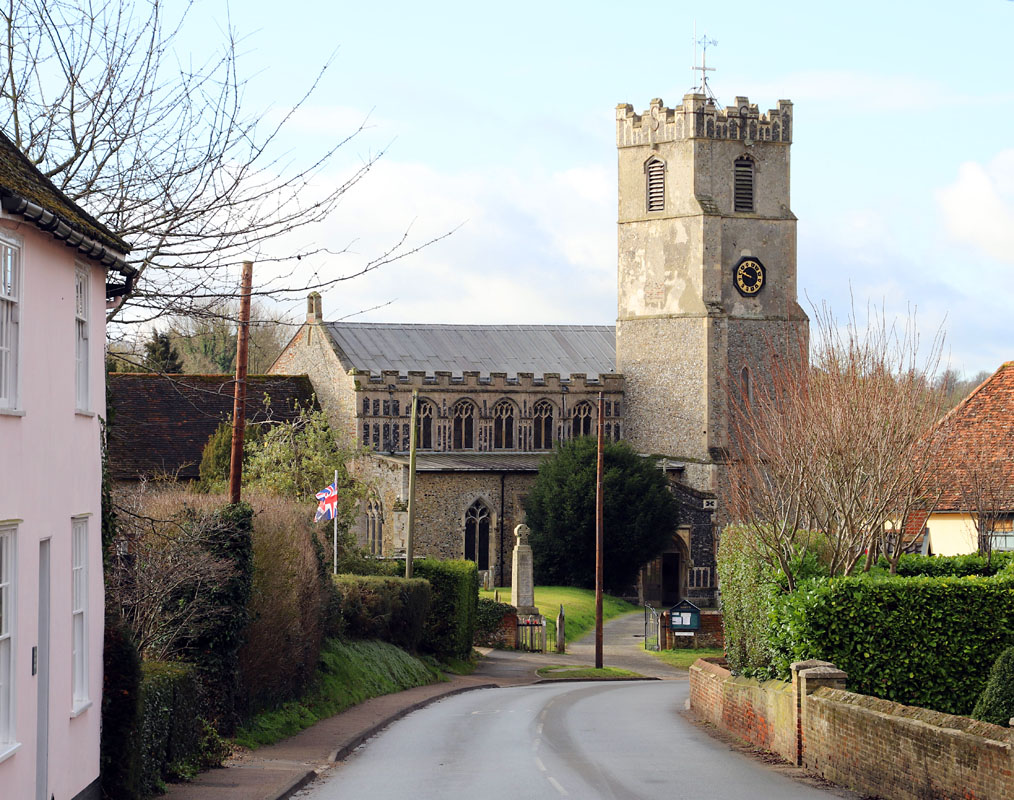
St Mary's does not appear in Simon Jenkins' list of England's Thousand Best Churches. Quite why is moot, but it probably should have been, even if just to mention the curious north porch angled to be aligned with the village main street, the spectacular clearstory. the offset tower, its elongated chancel or the carved wooden angels looking down from the double hammerbeam nave roof.
The church built of flint and stone has norman origins but the edifice we see today is mostly 15th and 16th century work. Restorations were carried out in 1886 (under E F Bisshopp of Ipswich) and again in 1893-1899 by the well known Anglo-Catholic Priest/Architect Rev. Ernest Geldart rector of Little Braxted, Essex. Geldart designed the chancel's barrel ceiling and flooring and replaced the old vestry with a new one adding an organ chamber.1 He also designed the stained glass for the east window and the reredos of oak and high relief, both of which were executed by Percy Bacon and Brothers.2 The reredos, which replaced an earlier one, was dismantled at some stage, possibly in the 1950s. There is now a fine oak frame from which hang Marian Blue curtains.
Posted 03 Mar 2022. Updated 17 March 2026.
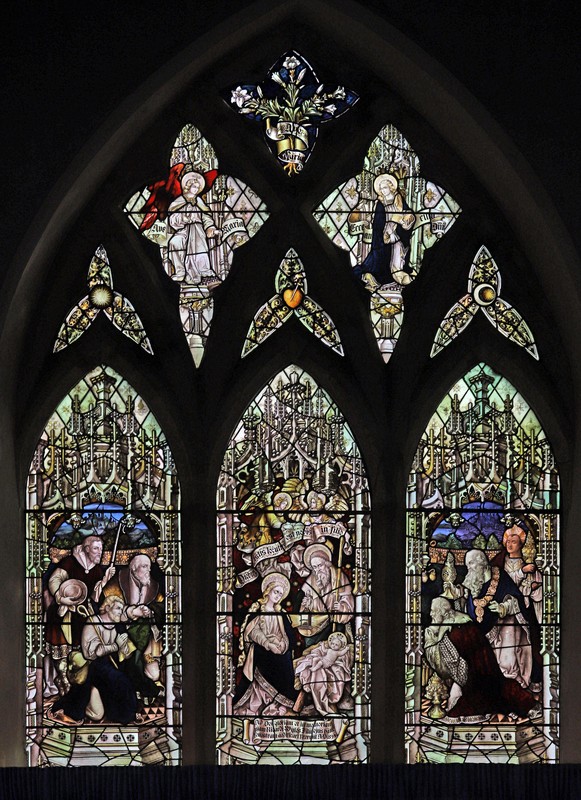
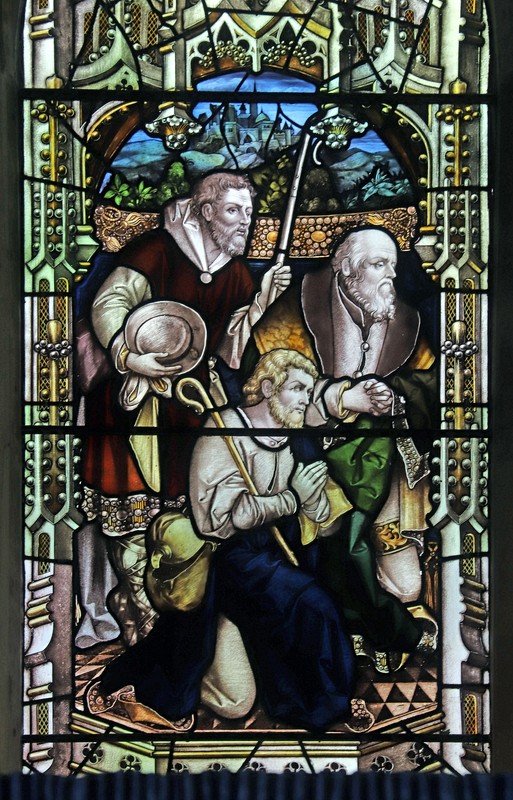
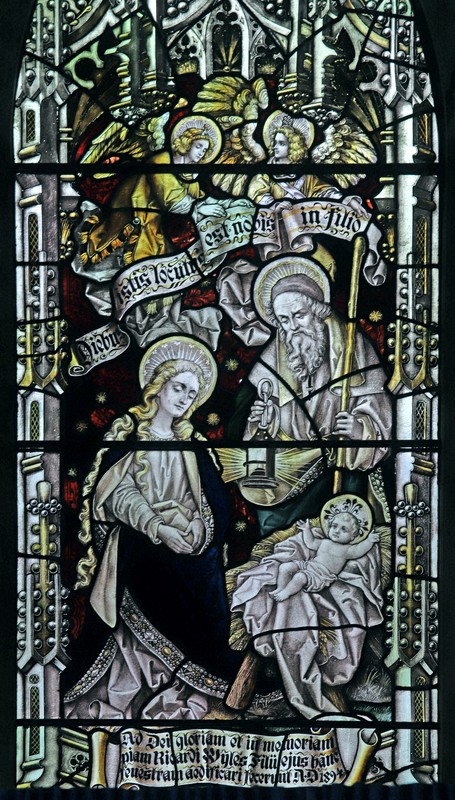
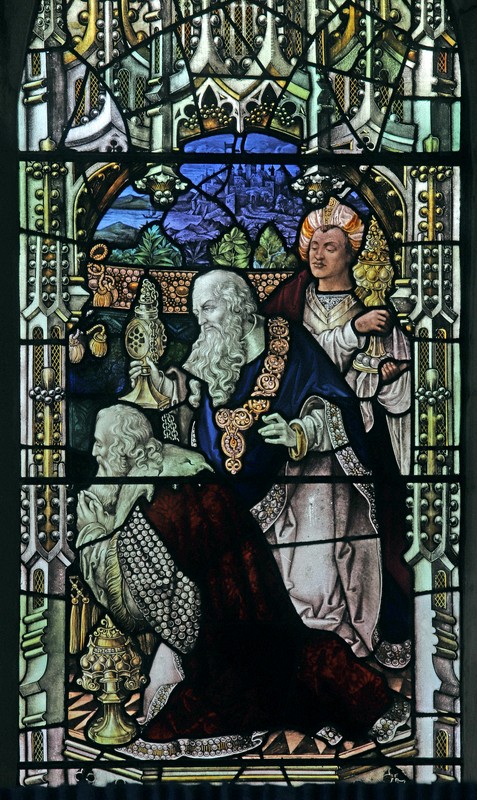
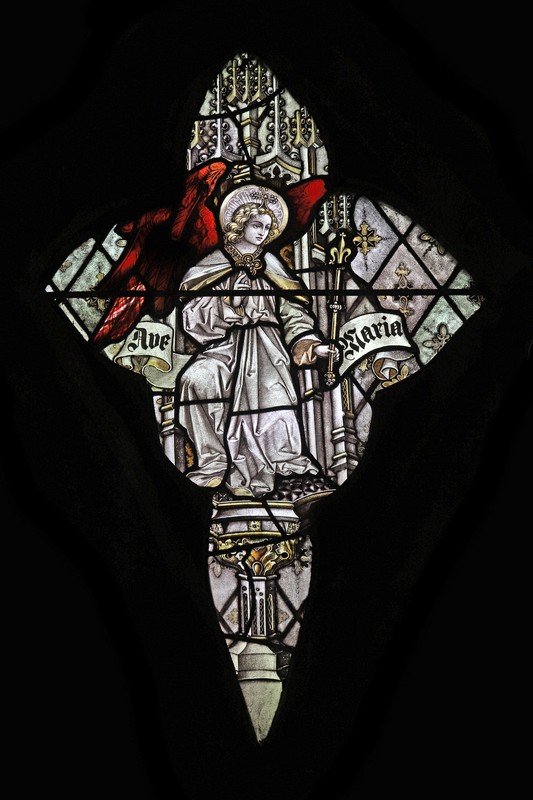
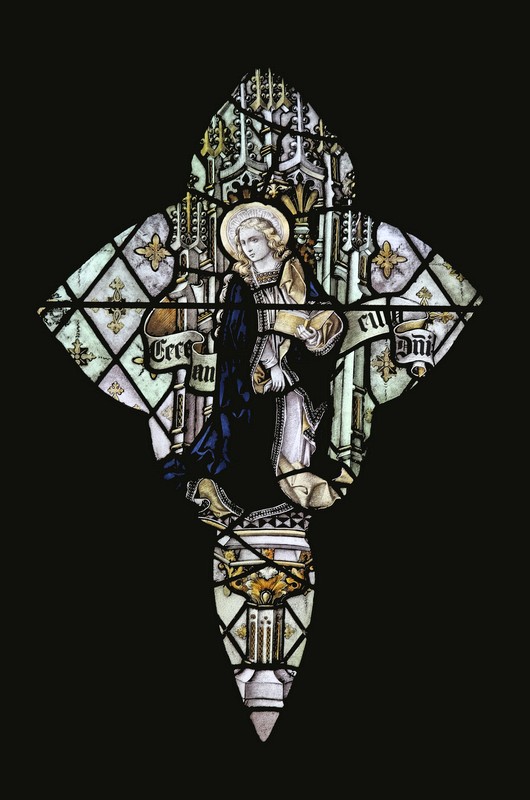
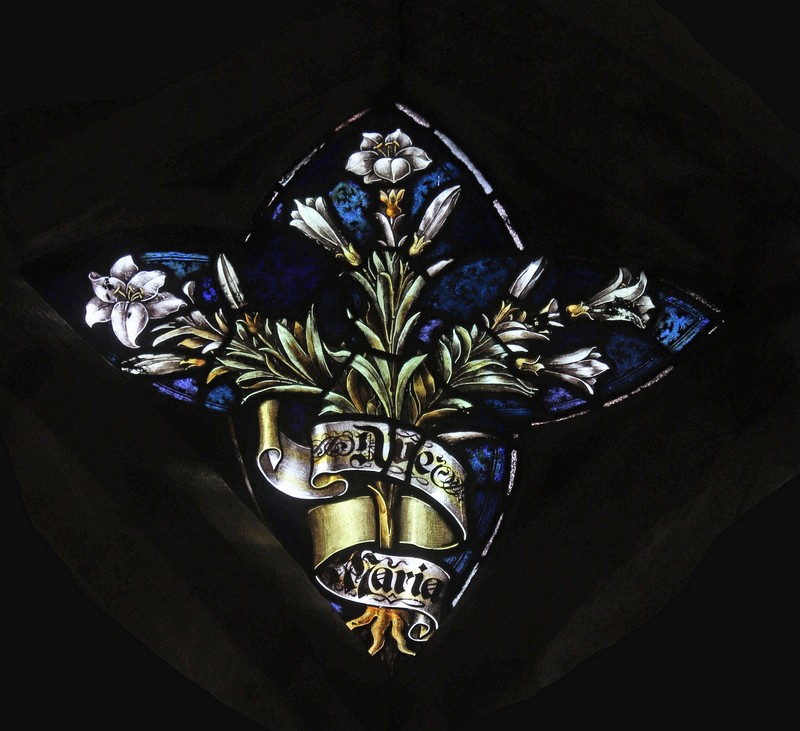
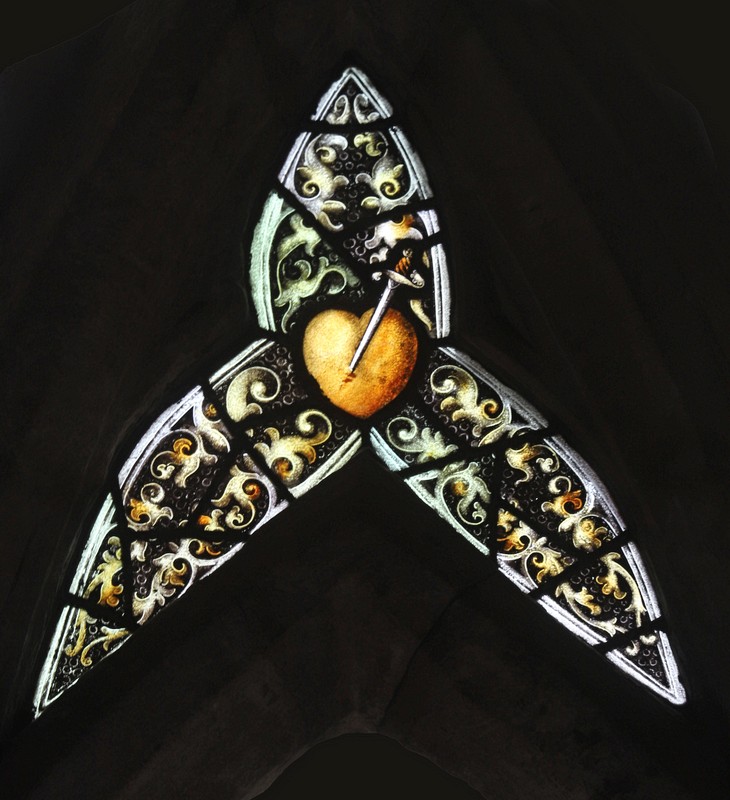
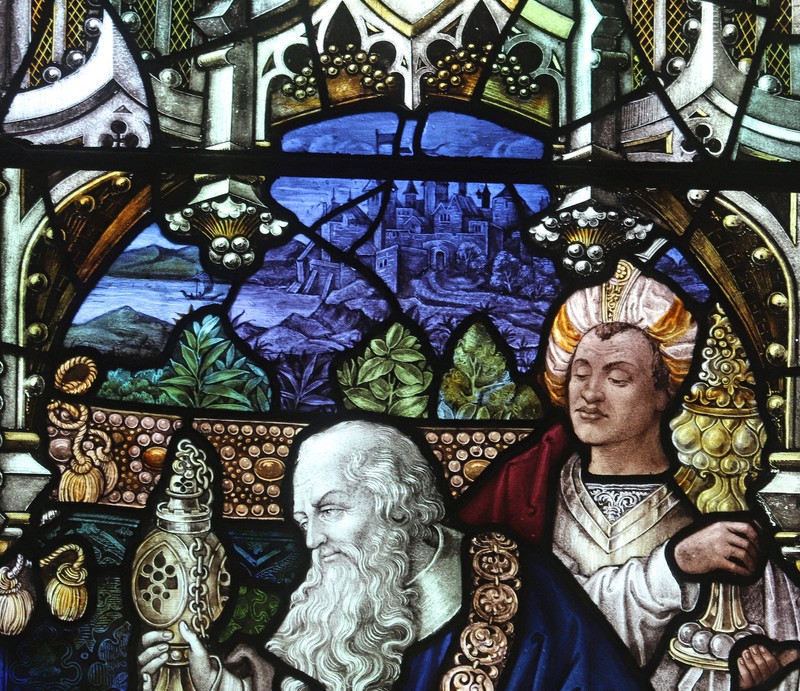
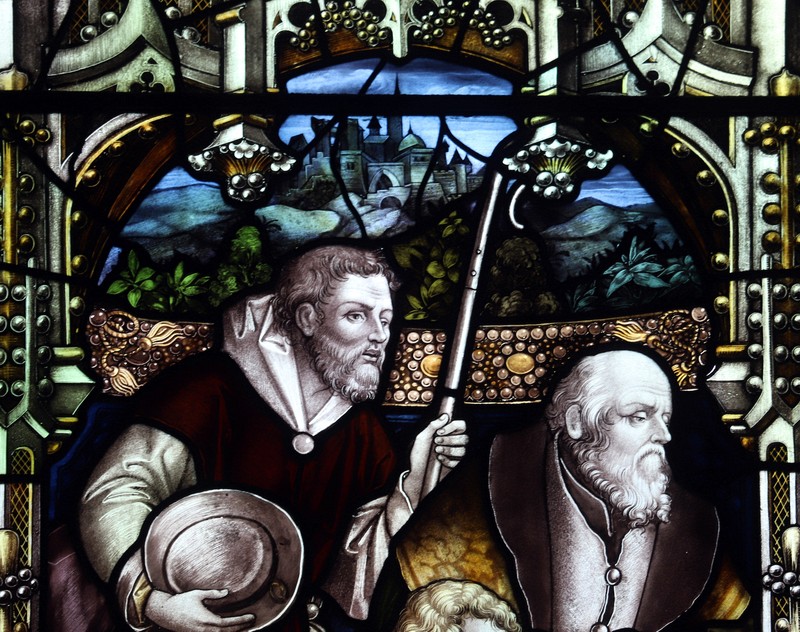
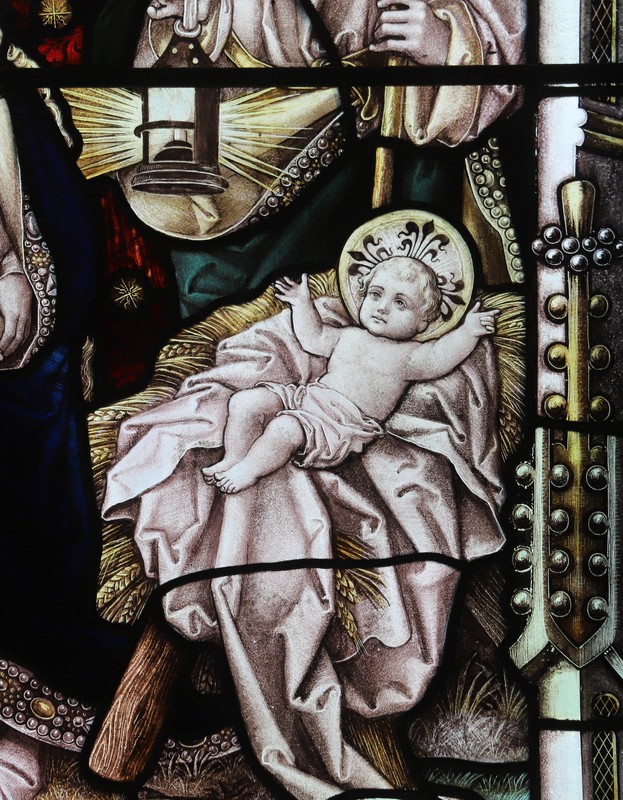
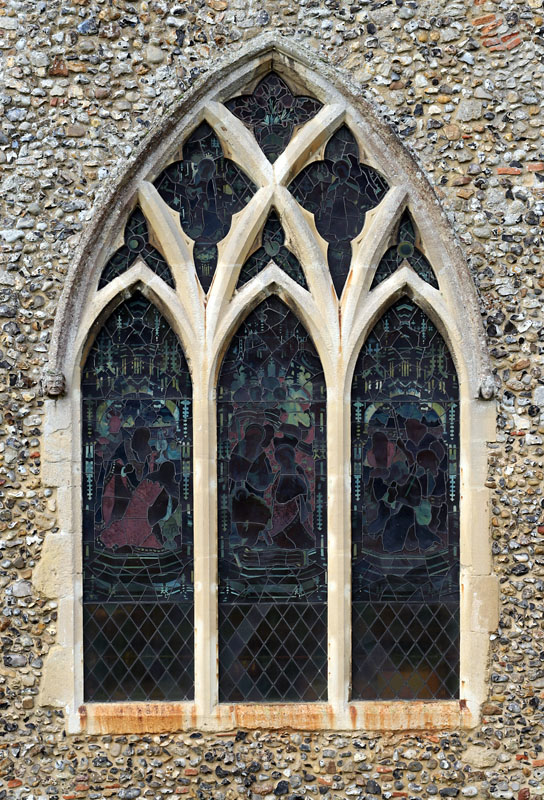
The east window installed in c1895 was designed by the prolific priest and architect, Rev Ernest Geldart, and executed by Percy Bacon and Brothers. Bacon worked on many projects with Geldart, especially in East Anglia. The theme of the window is The Nativity, and the Adoration of the Magi and Shepherds. In the tracery are images of the sun and moon and a pierced heart representing the sacrifice of Christ, and above an annunciation scene ("Ave Maria", "Ecce ancilla Dni") the diminutive figures of Gabriel and The Virign Mary within their own chequered floored niches. A the top, a lily.
Unfortunately the base of the window is obscured by the curtain installed as a replacement for the dismantled reredos which were also executed by Bacon to Ernest Geldart's designs in 1898. The base of the window is, in fact made up of regular diamond quarries. It is unclear whether these were installed at the same time as the stained glass, as this portion of the window would have been covered by the reredos in any case, or whether they replace an extension to the scenes in the earlier window. However, viewed from the outside it looks like the latter is more likely due to the mismatch.
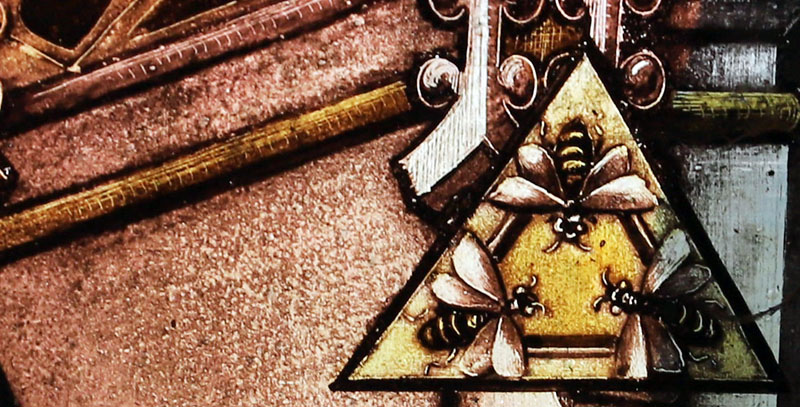
This window is a very good example of the dedication of the glass painter. The detail in the main lights is exquisite; the background townscapes or the angel's feathers and the intricate canopy work. Each window tells its own story, each scene placed on a pedestal with wide columns in mostly white glass, and canopies as framing devices, as if the figures are on a stage. The window is signed with the Percy Bacon & Brothers "three busy bees" rebus, though this is obscured by the curtain. The window was donated by Walter Wyles, the rector's brother, in memory of his father Richard.3
Birkin Haward reported the earlier stained glass in the east window of St Mary's as being installed in 1832 by S. C. Yarrington of Norwich. This window, he stated, had, "splendid heralidic stained glass". Haward goes on to say that it was "destroyed" in 1892 or 1893. What the mode of destruction was he does not say, and it may be possible that it was just removed.4 This earlier window was the gift of the Rev. John Longe, vicar of Coddenham 1797 - 1834.5
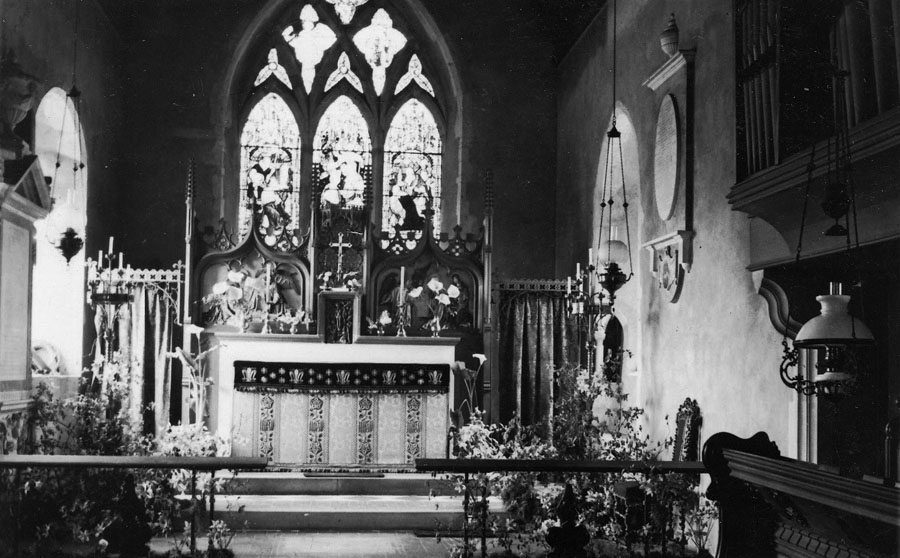
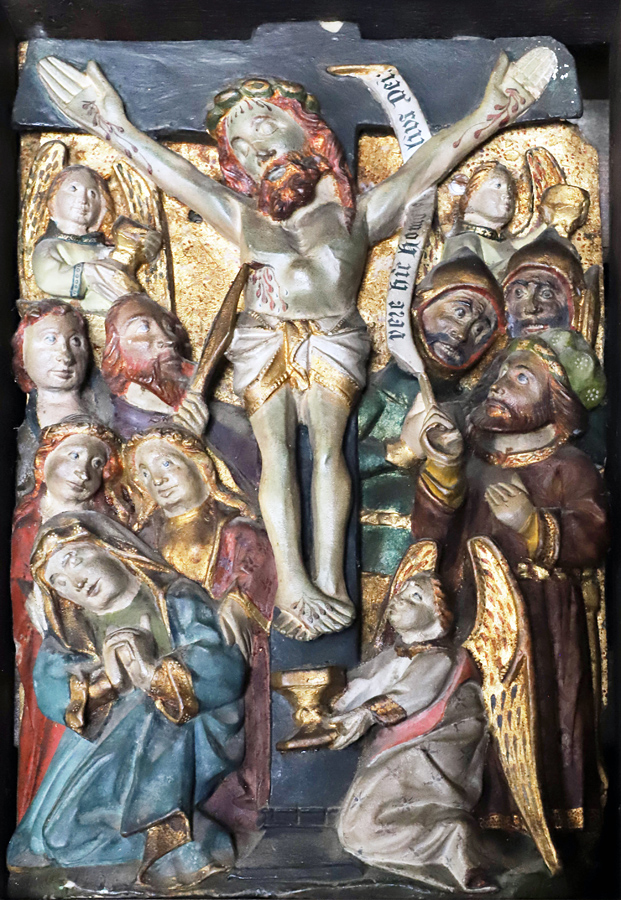
Note the c14/15 crucifixion panel fixed to the altar. PD Image.

Early 20th century photo of the Bacon reredos designed by Ernest Geldart.
PD Image.
Posted 16 March 2026.
This entry is an update following a revisit to St Mary’s in March 2026, when further information came to light enabling a fuller description of the reredos executed by Percy Bacon & Brothers.Fn1 The new reredos was dedicated in December 1898.
Designed by Ernest Geldart, the new reredos replaced an earlier one which appears to have been partially renovated in 1893 (probably by Bacon) at the time the new east window was put in, and when other works were carried out. The reredos was a gift of the vicar "and friends".6 At the very least a panel with a representation of the crucifixion which had stood in the vestry was reported as having been regilded and, “Fixed in a panel forming part of the reredos".7 This panel, a polychrome sculpted alabaster bas relief, is said to be 14th or 15th century, and formed part of a much earlier reredos. It was reported to have been found in 1774 durig the course of some repairs to the roof of a house near the church, when it still retained some traces of elaborate gilding.8 It is possible that the panel was removed and hidden to prevent destruction at the hands of the iconoclasts.
The Geldart reredos was carved from oak. The following description is from the early 20th century photographs reproduced above. It consisted of three sections, bracketed by tall crocketed spirelets. The two outer panels contained the plaster relief scenes fixed to heavily gilded wooden boards (see below), framed by an ogee shaped moulding whose centres rise to form crosses. Behind these panels are ornately carved crestings springing from spandrels. These are adorned with eight small shields. It is possible these were introduced to replace the coats of arms of various branches of the Bacon (Shrublands) family in the east window which was taken down in 1893 prior to the installation of the Bacon window. The central, narrower panel of the reredos is a finely carved niche with a canopy, its background adorned with flower motifs. In the photographs a silver cross stands in the niche, possibly its primary purpose. The reredos was removed (it is said) in the 1950’s due to some distaste of “Victorian” embellishments, its constituent parts still to this day stored in various parts of the church. A detailed inspection would enhance this description of the Bacon reredos, if not its restoration. However, the two plaster reliefs are now displayed high on the west wall of the nave. .
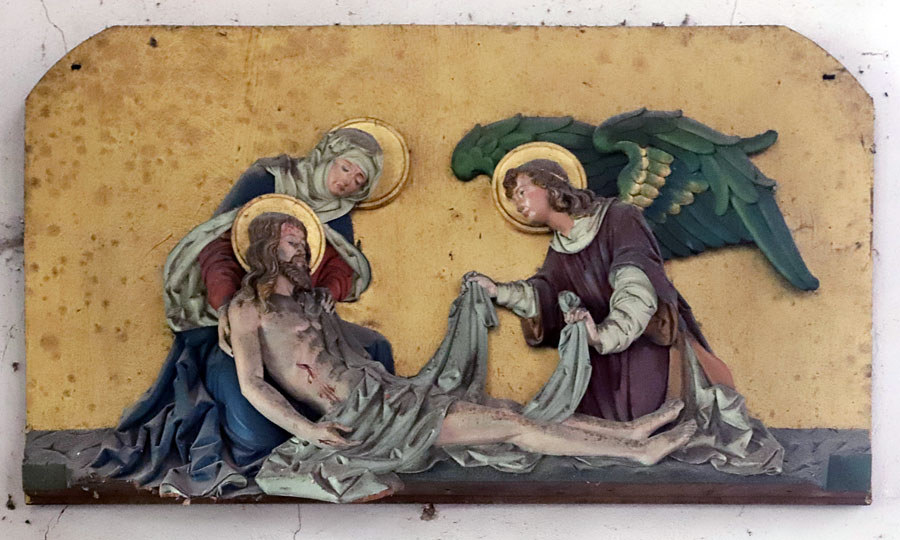
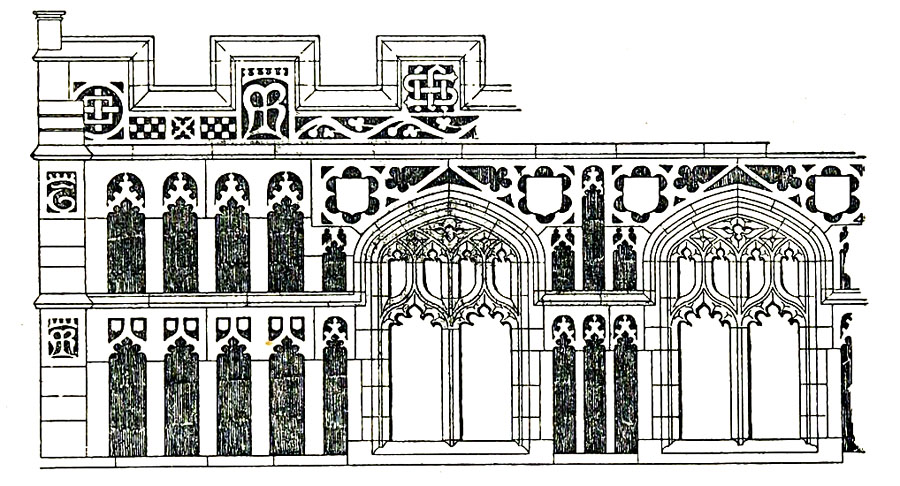
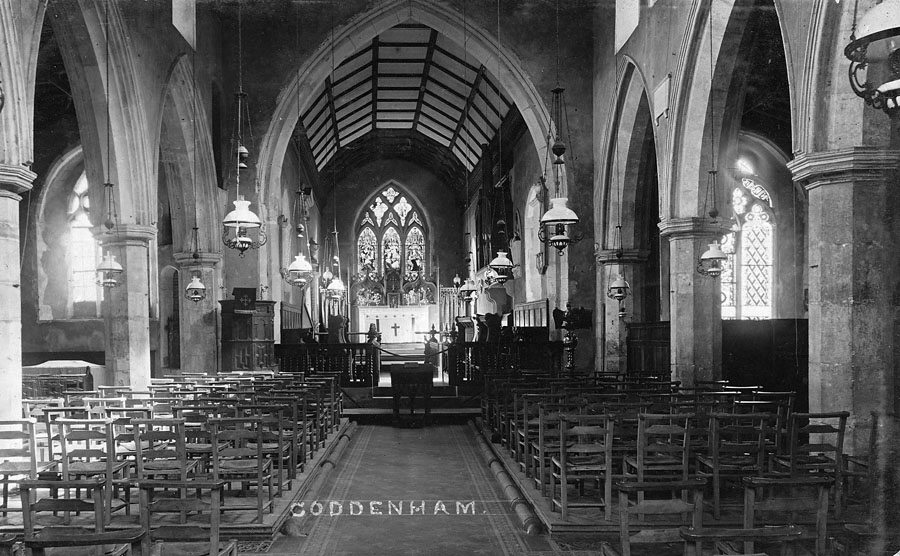
The photograph above, probably taken in the early 20th century, shows the new (Geldart/Bacon) reredos, with the two plaster relief panels incorporated, and the earlier mentioned c14/15 crucifixion panel (unusually it would appear) mounted centrally on the altar. The two panels on the reredos depict; south side: The Pietà – The Blessed Virgin Mary cradling the mortal body of Jesus Christ after his Descent from the Cross with an attendant angel – and on the north side two figures meeting an angel at the empty tomb. See below for further commentary on the latter. Note the reredos which is extended to the north and south walls by curtain hangers, is set well forward of the east wall (as is still the case with the altar today).
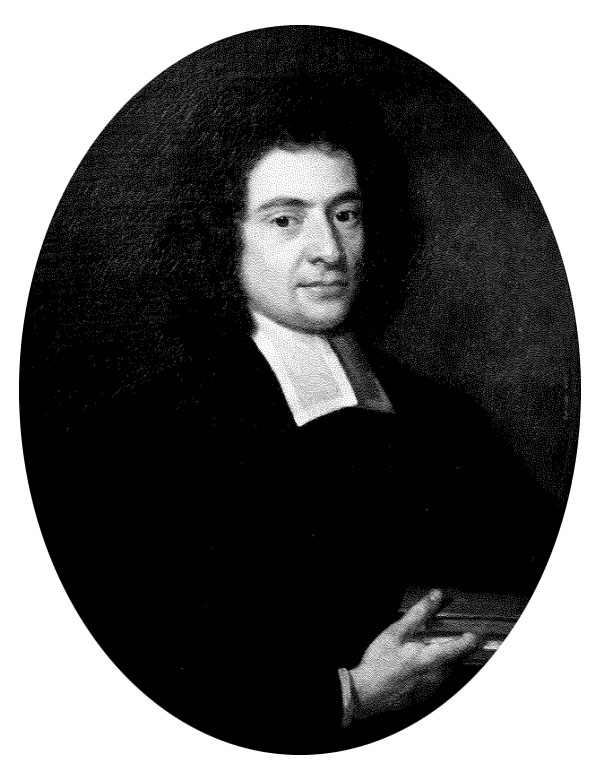
The altar was moved forward in 1893 to a position "where it formerly stood”, because the tomb of the Rev. Balthazaar Gardemau, and his wife, Catherine lies (as mentioned on a memorial in the church) “behind the altar”.9 The Rev. Gardamau was rector of St Mary's from 1690 - 1739.
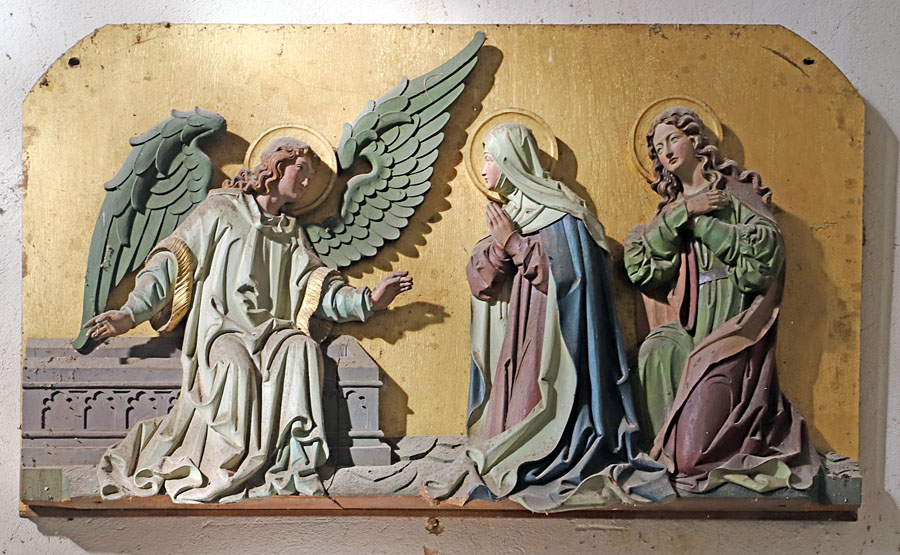
The panel originally on the north side of the 1898 reredos..
The iconography of the north side panel is a little confusing. Two figures are portrayed meeting an angel at the empty tomb. Both figures are haloed. The central figure is clearly a veiled woman. However, the right hand figure is somewhat androgynous in appearance having feminine facial features and long curling hair, but is not veiled. Is this a young, unbearded man, or an unveiled woman? The four New Testament Gospels vary considerably in their telling of the discovery of Christ’s empty tomb, but this panel does not seem to fit any of them. John (20:1-5) tells of Mary Magdalene going to the tomb alone, and, finding it empty, runs to the disciples to tell them. John & Peter run to the tomb to investigate, and John arrives first having outrun Peter. John's Gospel narrative does not mention an angel being seen by Mary Magdalene or the two disciples, nor does it say that Mary Magdalene was with John when he witnessed the empty tomb, having got there before Peter (and presumably Mary). However, John continues (20:11-18) to tell of Mary weeping outside the tomb and seeing two angels before Jesus appears to her. Mark (16:1-8) tells of three women called Mary attending the empty tomb and encountering a “man dressed in white” who tells them Jesus has risen. The next verse continues the narrative with Jesus’s appearance to Mary Magdalene. Matthew (28:1-6) tells a different story. Here Mary Magdalene and “the other Mary” go to the tomb and meet an angel who tells them Jesus has risen. They both run to tell the disciples of the encounter and meet the risen Christ en-route. Luke is a little less specific in his telling of the story. He relates (23:55-56 and 24:1-) that the (un-numbered) women who had accompanied Joseph of Arimathea from Galilee went to the tomb and saw “two men” in “clothes that gleamed like lightning” who told the women that Jesus was risen.
There are two possibilities to explain the iconography of this panel. First, that the panel represents Matthew 28: i.e. Mary Magdalene and the “other Mary” meeting the angel. This would have us believe that the other Mary is (for some reason) unveiled. A more likely explanation is that the figure on the right represents, “the disciple whom Jesus loved” – i.e. John – and that the scene depicted is a conflation of John 20 and Matthew 28, John's gospel providing the figures of Mary Magdalene and John, while Matthew provides the angel (only Matthew specifically mentions an angel, the other synoptic gospels say the women saw, “men”). This conflation of stories is not unique in the output of Percy Bacon. His conflation of the Adoration of the Magi (Matthew) and Adoration of the Shepherds (Luke) not just in the east window at Coddenham but in a number of other churches is testament to his use of iconographical latitude. Indeed, this being relatively early work in the output of Bacon’s firm, it may have been Ernest Geldart who inspired Bacon to freely interpret the Bible in this manner.
Incidentally, the church guide first published in 1988, and revised in 2000 and 2012, says that this panel represents an Annunciation scene. However, “Annunciation” in this context normally refers to the Annunciation made by the angel Gabriel to Mary.10
References: Use your browser's Back button to return to text.
- East Anglian Daily Times - Thursday 02 November 1893, p7.
- Bettley, J. ‘A month in the country: Rev. Ernest Geldart 1881’. Proc.- Suffolk Institute of Archaeology & History vol.42, part 4, 2012 pp.490-503. Note 41.
- Report on the installation of the reredos; The Building News and Engineering Journal, Vol 76 10 Feb 1899, p220.
- Haward, Birkin. Nineteenth century Norfolk stained glass : gazetteer, directory : an account of Norfolk stained glass painters. 1912. p218 & p279.
- Ipswich Journal - Friday 21 January 1887. p3. Report on the restoration of the church.
- The Builder 14 Jan 1899: Vol 76, p50.
- East Anglian Daily Times - Thursday 02 November 1893, p7.
- Ipswich Journal - Friday 21 January 1887. p3. Report on the restoration of the church.
- Ibid. See also A Short History of St Mary’s Church, Coddenham p9.
- A Short History of St Mary’s Church, Coddenham – Available in the church.
- During a revisit to St Mary's in March 2026, I was very lucky to meet one of the churchwardens who kindly showed me the c14/15 alabaster relief from the earlier reredos, and pointed me to the two Bacon polychrome reliefs now displayed on the west wall of the nave. He was also able to furnish me with the two early 20th century photographs which show the Geldart/Bacon reredos in situ, as well as providing valuable historical information.
Location Map:
Sat Nav Post Code: IP6 9PZ