
Stained Glass of Percy Bacon & Brothers
- Home
- Life
- UK County List
- Bedfordshire
- Berkshire
- Bristol
- Buckinghamshire
- Cambridgeshire
- Cornwall
- Cumbria
- Derbyshire
- Devon
- Dorset
- Dumfries & Galloway
- Durham
- East Sussex
- Essex
- Gloucestershire
- Gtr Manchester
- Hampshire
- Herefordshire
- Hertfordshire
- Kent
- Leicestershire
- Lincolnshire
- Gtr London
- Barnes:
St Michael - Camden:
St James † - City: St Dunstan-in-the-West
- Clapton,
Christ Church† - Croydon: Woodcote
- Ealing:
Christ Church† - Ealing: St Saviour†
- Hammersmith
St Paul - Hornchurch
- Little Ilford
- Islington, St Paul†
- Kensington:
St John the Baptist - Mortlake:
St Mary Mag, RC - Perry Hill,
St George† - Roehampton
- Romford, St Edward the Confessor
- Twickenham,
St Stephen - Upminster,
St Laurence - Upton Cross,
St Peter† - Woolwich Garrison†
- Woolwich:
St Michael - Yiewsley
- Barnes:
- Midlothian
- Merseyside
- Norfolk
- North Yorkshire
- Northamptonshire
- Northern Ireland
- Northumberland
- Nottinghamshire
- Oxfordshire
- Pembrokeshire
- Rutland
- South Yorkshire
- Somerset
- Suffolk
- Surrey
- Tyne & Wear
- Warwickshire
- West Sussex
- Wiltshire
- Worcestershire
- Non UK
- Gazetteer
- Contact
- Essays
- Lost Work
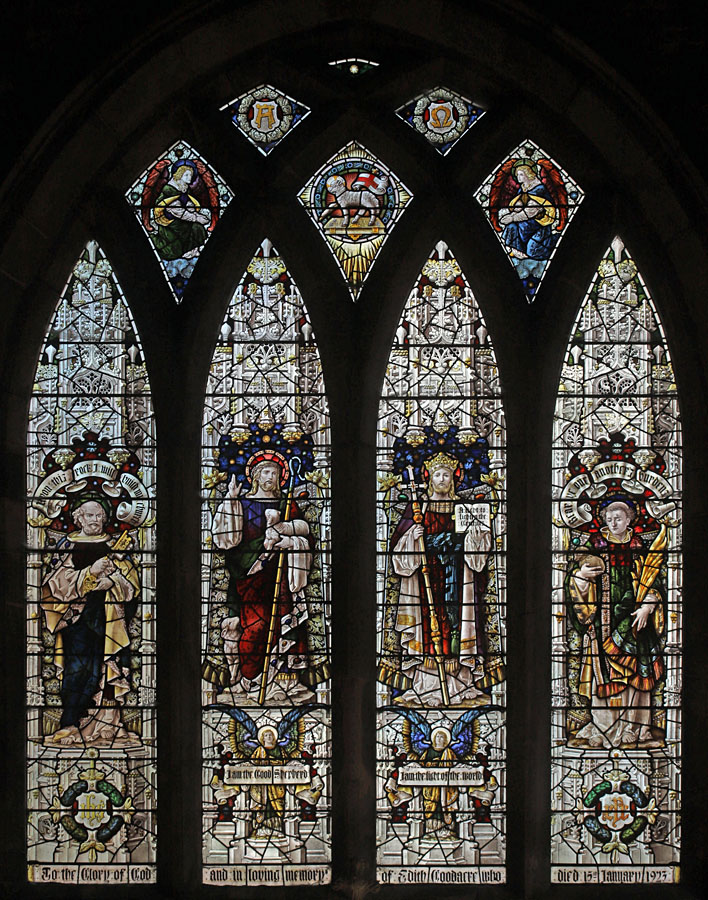
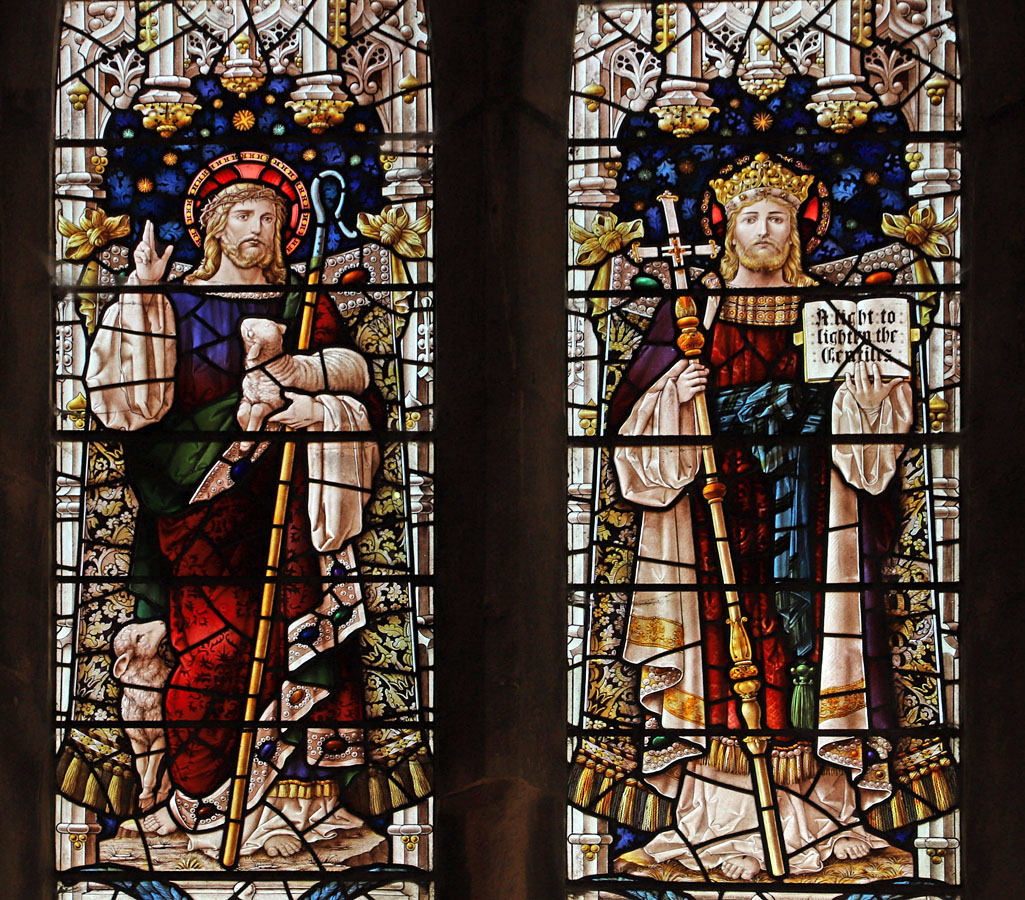
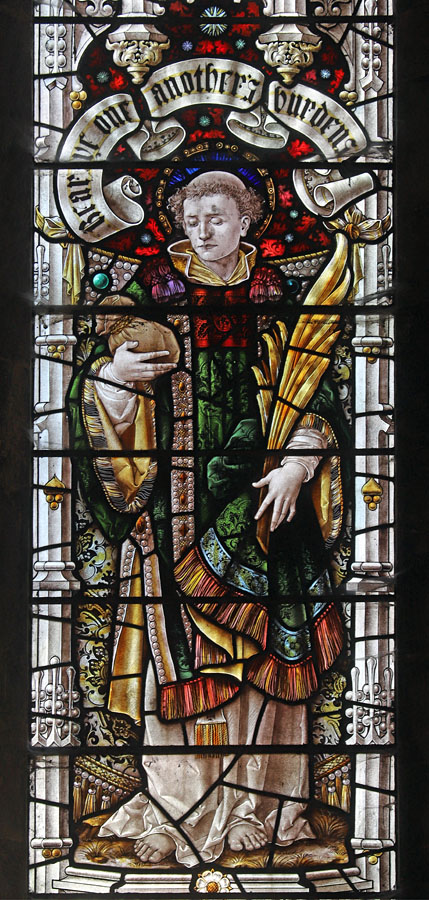
East window: Jesus as Good Shepherd and Light of the World. St Peter and St Stephen. 1928.
Posted 28 September 2025.
Although this is a rather late window in the output of the Bacon Studios, correspondence between Percy Bacon and the window's donor, the Rev. Charles Bailey Goodacre, housed in the Lincolnshire Archives, shows that Percy Bacon himself was still very much the front man of the firm.1
It is clear from this correspondence that a material change to the design occurred sometime between August 1927 and the window's installation in March 1928. In a letter dated 8th August 1927, Percy Bacon describes the design as follows:
Bacon goes on to describe other elements of the window's design, the tracery lights and other details which were faithfully executed. The main difference between Bacon's description and the finished window is the substitution of another saint in the rightmost light, and an altogether different inscription on the scroll above the figure. This figure is a little ambiguous. He is clearly a tonsured monk (though dressed in rich clerical robes), and he holds in his left hand a martyr's palm, and in his right a bag. What the bag contains is moot. If stones, then this could be a representation of St Stephen, the first Christian martyr. Above the figure the scroll reads: "Bear us one another's Burden" (Galatians 6:2). Unfortunately the correspondence in the Lincolnshire Archives does not shed any light on this change, who instigated it, or when. All the figures stand within Bacon's trademark architectonic niches which are overly fussy and flamboyant in this window. In his letter to the Rev. Goodacre, Percy Bacon rather cryptically says that the design was a copy of No. 4081, though no similar design has yet come to light.
In the tracery are the usual Alpha and Omega symbols, and below those two adoring angels flanking an Agnus Dei standing on the "Book sealed with Seven Seals".
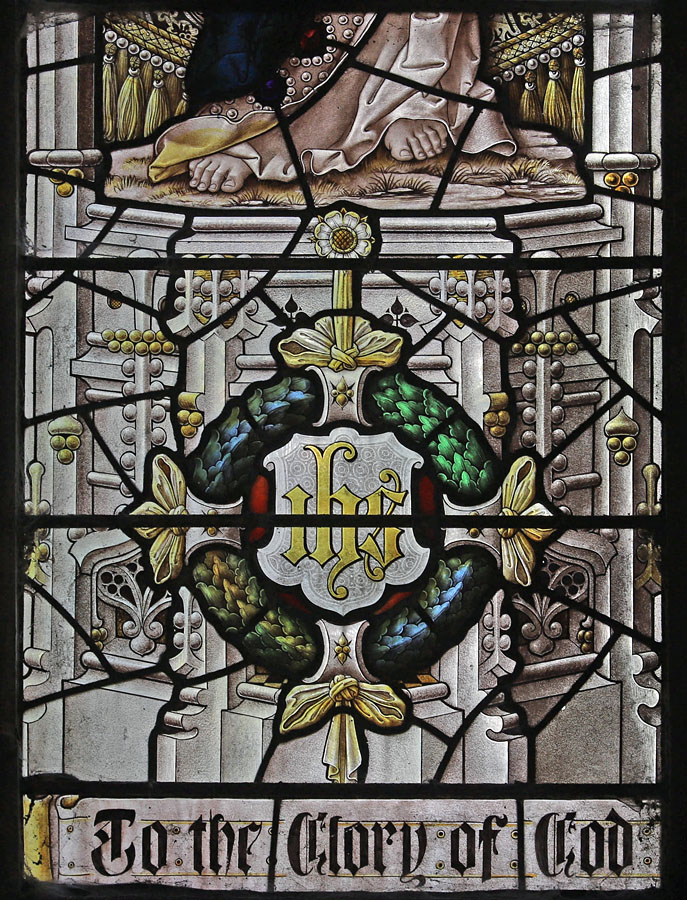
The window is dedicated to the Rev Goodacre's wife Edith. The inscription reads:
The window is signed, PERCY BACON ...LONDON, but part of the signature is obscured by the leading at the top of the inscription panel.





The Thornton Curtis Font.
Posted 28 September 2025.
Entering the village of Thornton Curtis the road signs proudly proclaim, "Home of a Tournai font", and it is well worth a little detour. The display board in the church proclaims it as, "One of the greatest treasures within the church". The font was made in the 12th century and carved out of a block of black marble (or limestone) found on the banks of the River Scheldt at Tournai (now in Belgium). It is one of a just seven complete examples surviving in England. Due to their size and weight the final destinations for these fonts were chosen for their proximity to rivers, as transportation over long land distances would have been considerably more difficult. The Thornton Curtis font is likely to have been transported up the Humber Estuary. There are two examples in Lincolnshire, one at Thornton Curtis, and the other in Lincoln Cathedral.
On the face of the square table top are representations of mythical creatures, birds and lions. On the east face are four winged creatures with long dragon's tails, and duck-like beaks in two pairs, each pair facing each other, and seem to be pecking at a fleur-de-lys. Their tails sport a head which nibbles at their own feet. On the south face are four griffin like creatures in two pairs in the same arrangement as the east side. On the west side two lions, one at each end seem to be attacking two large birds conjoined at the breast. It is difficult to know whether the central creatures represent two birds or a single one with two heads. The north face sports four lion like creatures again in two pairs.
The Lincoln Cathedral example has carvings similar to those on the Thornton Curtis font, suggesting they may have been manufactured together as a pair. The Society for Lincolnshire History and Archaeology suggests that the font at Thornton Curtis originally belonged to the Knights Templar.2

North face.

East face.
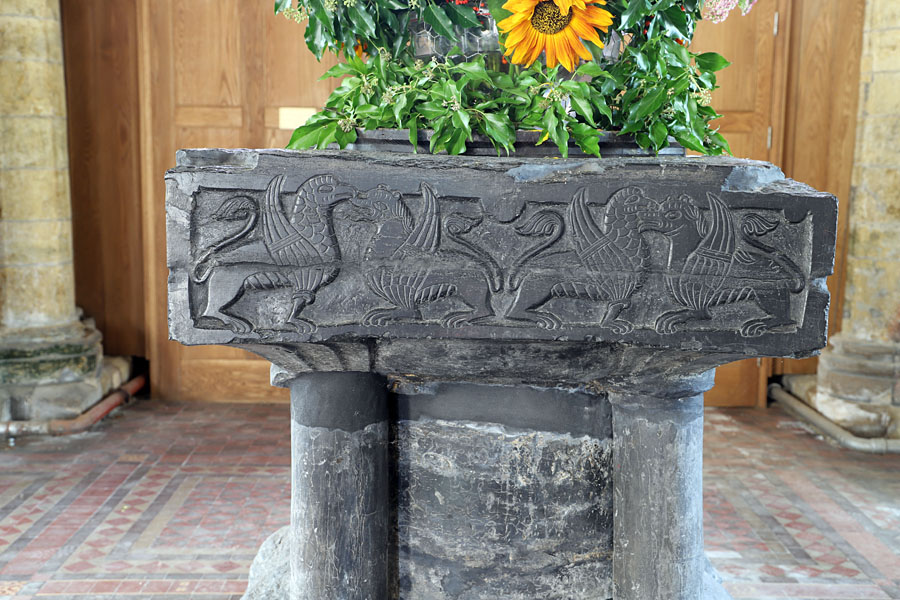
South face.

West face.
References: Use your browser's Back button to return to text.
- Lincolnshire Archives. Document Ref: THORNTON CURTIS PAR/9/14. Acc. No. 2012/102:01. Letters re stained glass window from Percy C. Bacon, London.
- Society for Lincolnshire History and Archaeology website.
Location Map:
Sat Nav Post Code: DN39 6XW