
Stained Glass of Percy Bacon & Brothers
- Home
- Life
- UK County List
- Bedfordshire
- Berkshire
- Bristol
- Buckinghamshire
- Cambridgeshire
- Cornwall
- Cumbria
- Derbyshire
- Devon
- Dorset
- Dumfries & Galloway
- Durham
- East Sussex
- Essex
- Gloucestershire
- Gtr Manchester
- Hampshire
- Herefordshire
- Hertfordshire
- Kent
- Leicestershire
- Lincolnshire
- Gtr London
- Barnes:
St Michael - Camden:
St James † - City: St Dunstan-in-the-West
- Clapton,
Christ Church† - Croydon: Woodcote
- Ealing:
Christ Church† - Ealing: St Saviour†
- Hammersmith
St Paul - Hornchurch
- Little Ilford
- Islington, St Paul†
- Kensington:
St John the Baptist - Mortlake:
St Mary Mag, RC - Perry Hill,
St George† - Roehampton
- Romford, St Edward the Confessor
- Staines
- Twickenham,
St Stephen - Upminster,
St Laurence - Upton Cross,
St Peter† - Woolwich Garrison†
- Woolwich:
St Michael - Yiewsley
- Barnes:
- Midlothian
- Merseyside
- Norfolk
- North Yorkshire
- Northamptonshire
- Northern Ireland
- Northumberland
- Nottinghamshire
- Oxfordshire
- Pembrokeshire
- Rutland
- South Yorkshire
- Somerset
- Suffolk
- Surrey
- Tyne & Wear
- Warwickshire
- West Sussex
- Wiltshire
- Worcestershire
- Non UK
- Gazetteer
- Contact
- Essays
- Lost Work
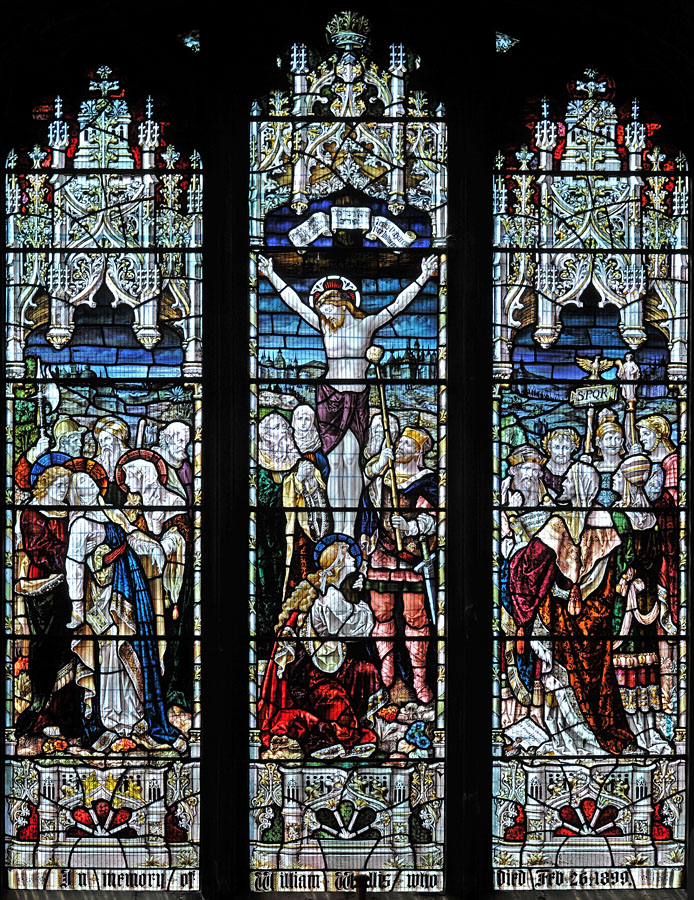
South Aisle 2: Crucifixion 1901. Photo courtesy Corpus Vitrearum Medii Aevi (2025) Corpus Vitrearum Medii Aevi Digital Archive. York: Archaeology Data Service, under Creative Commons License CC-BY-4.0.
South Aisle 2: Crucifixion. c1901.
Posted 20 June 2026.
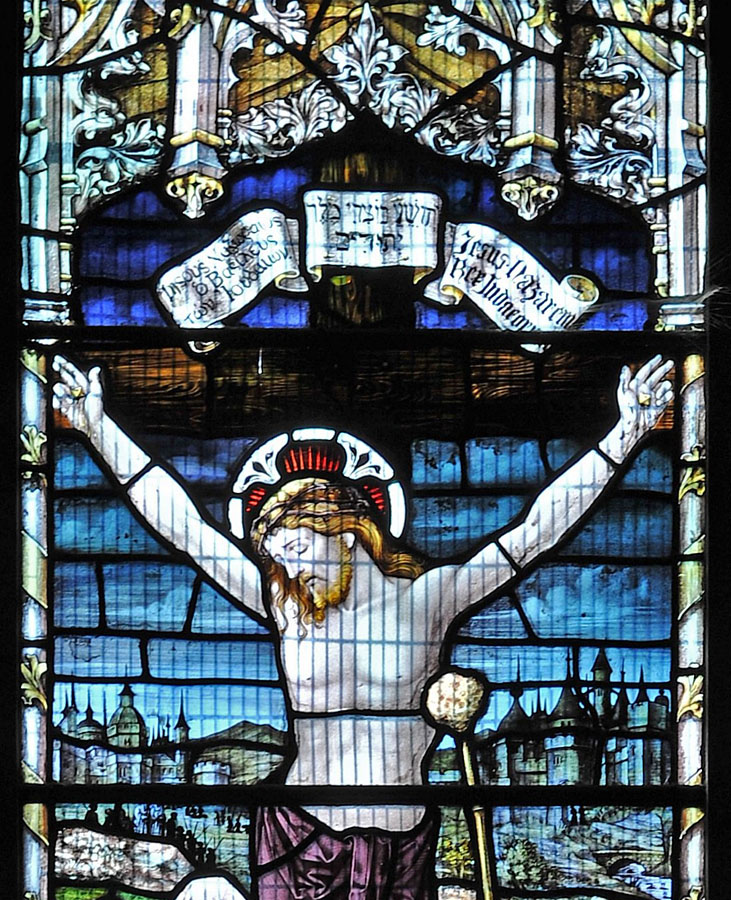
To look at this window casually, one may think it is just another crucifixion scene. However, to really appreciate it one should give oneself the luxury of time, because the detail is quite remarkable. Crucifixion scenes are, of course, common to all the Gothic Revival glass firms, and not unusual in the output of the Bacon Studio, but this window is unique in its attempt not only to faithfully represent the story of the Passion, but also includes apocrypha. Much of the scene derives from John 19.
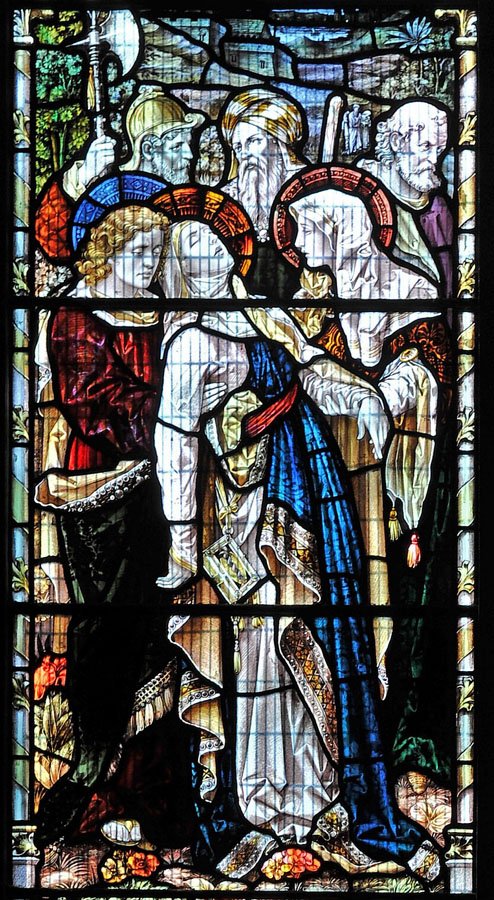
The contiguous scene plays out across the three lights under the trademark Bacon Studio's fussy architectonic canopies. Woven into these scenes are a number of unusual elements not normally incorporated into crucifixion artwork. The foreground at the foot of the cross is busy with, seventeen, mostly identifiable characters. In the left light, and from the apocryphal Gospel of Nicodemus, the Blessed Virgin Mary swoons at the sight of her son on the cross. She is supported by John (the disciple whom Jesus loved), and another woman. Behind this group are three men, a soldier and a turbaned man who appear to be conversing, and a third man, possibly just a bystander rather than a disciple as he is unhaloed.
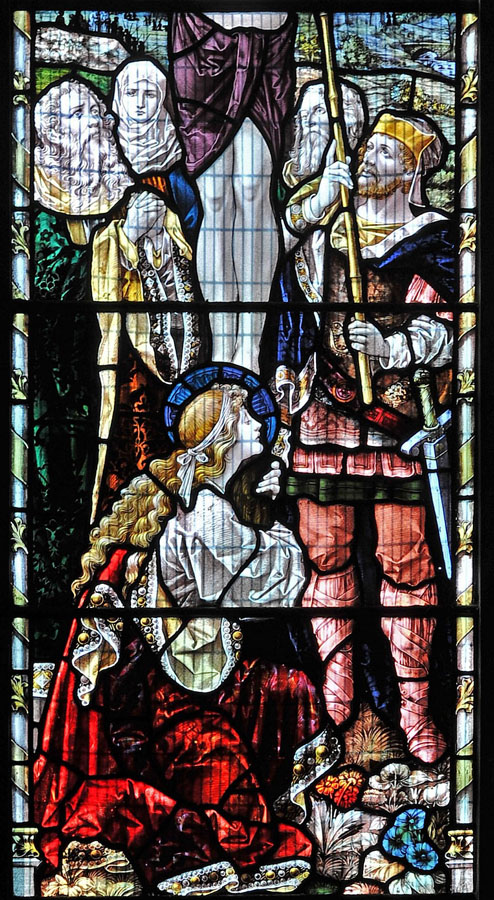
In the central light Mary Magdalene clings to the base of the cross. Behind are figures of four people, two unhaloed men and a woman at the rear, while in the foreground a soldier offers the sponge with vinegar and hyssop on a staff to Jesus. At the head of the cross three notices, are attached which read in Hebrew, Greek, and Latin, "Jesus of Nazareth, King of the Jews". Only John 19 and Luke 23 mentions Pilate mandating the fixing of the notice in three languages (KJV).
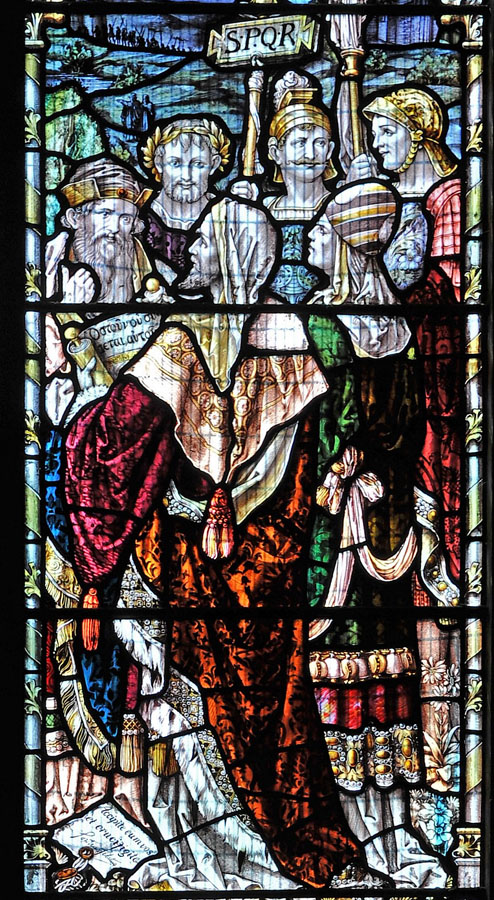
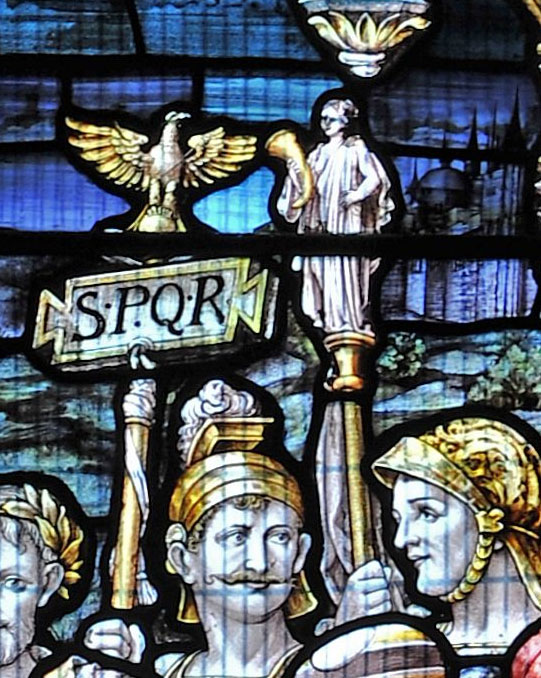
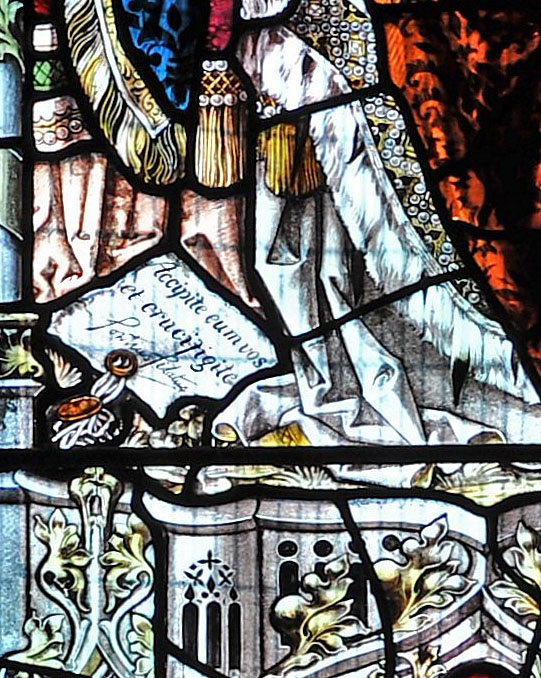
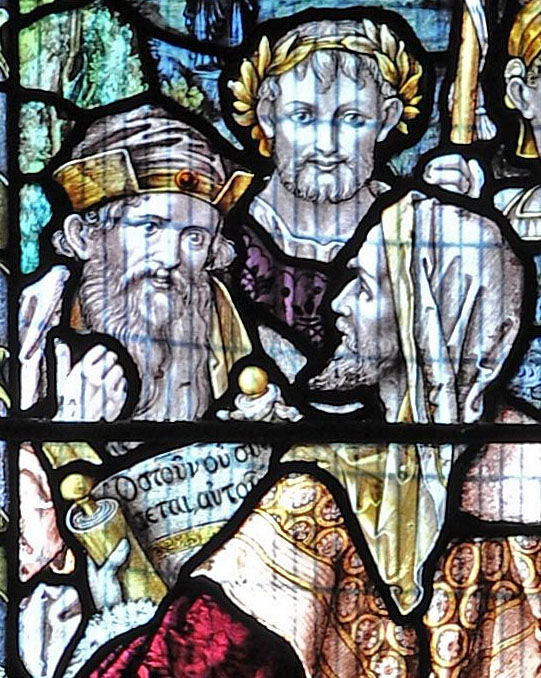
In the right light stand six men. Two are identified as Roman soldiers. One holds an SPQR standard, the other a standard on which is the carved image of a woman dressed in white who holds a cornucopia, or "horn of plenty". Is this the Roman goddess, Fortuna, symbolising luck, or perhaps more likely in this context, fate? The other figures in this light appear to be Jewish priests, likely representing those who had petitioned Pontius Pilate for Jesus's conviction. At the feet of one, as if casually discarded now the sentence was complete, lies a note signed by the governor himself, which reads, "Accipite eu mvos et crucifigite", "You take him and crucify him", (John 19:6). One of the priests holds a scroll, on which some Greek text from John 19:36 is partially revealed: "Ὀστοῦν οὐ συντριβήσεται αὐτοῦ"; "Not one of his bones shall be broken".
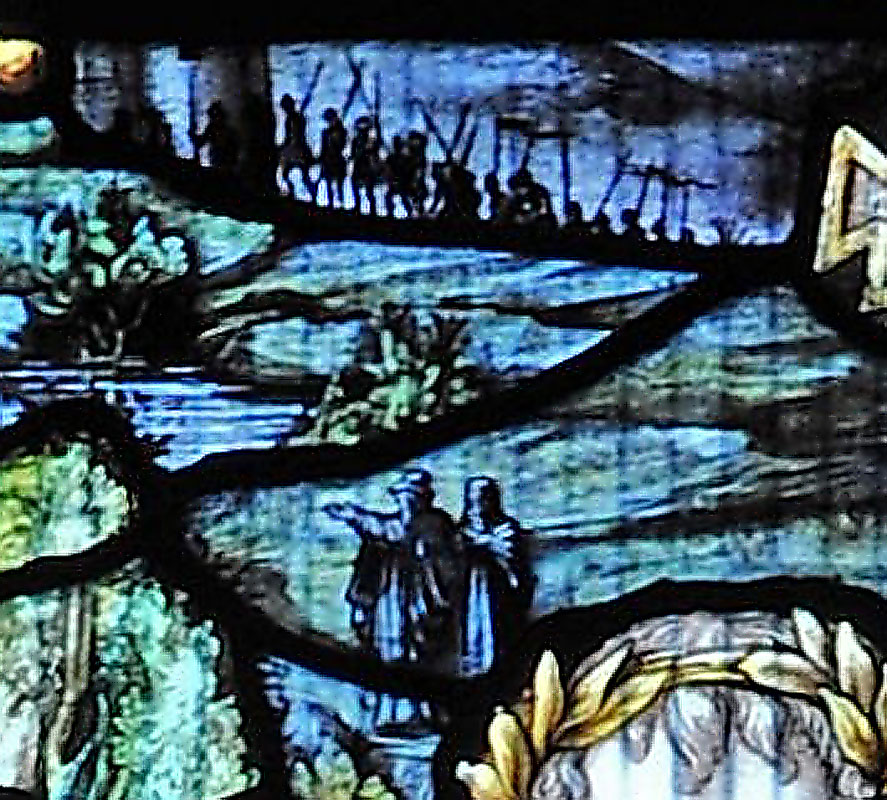
The receding backgrounds of the three lights with their darkening skies rendered in blue tones are also full of detail, some of which is hard to decipher. In the left light, and as if advancing towards the chaotic scene unfolding, are two (and possibly three) diminutive figures; a man and one or two women. Is this Joseph of Arimathea who was a secret follower of Jesus, and requested of Pilate that he be given permission to remove the body from the cross for burial. Although not mentioned in the crucifixion narrative, the gospel of Luke (23:55-56 and 24:1) in relating the story of the resurrection mentions Joseph having come from Galilee with a number of women. In this background is a body of water on which boats appear to sail. This is prehaps the Sea of Galilee? John (19:39) states that Nicodemus accompanies Joseph.
In the background of the centre light can be seen the walls and towers of a mythical Jerusalem, but rendered more like the gleeming spires of Oxford than a Middle Eastern city. Many figures carrying spears are sillhouetted against the backdrop. Similarly in the right light the silhouettes of a Roman legion with flying standard can be seen marching up the hill. There are also two mysterious figures, , one with arm outstretched as if pointing at the crowd gathered at the cross. It is difficult to identify these figures, but it is clear from their inclusion that there was an intention on the part of the designer of the window to impart another aspect of the crucifixion story.
The rather pithy dedication reads: "William Wallis who died Feb 26 1899." The window is unsigned.
Location Map:
Sat Nav Post Code: SS2 6LQ