
Stained Glass of Percy Bacon Limited
- Home
- Life
- UK County List
- Bedfordshire
- Berkshire
- Bristol
- Buckinghamshire
- Cambridgeshire
- Cornwall
- Cumbria
- Derbyshire
- Devon
- Dorset
- Dumfries & Galloway
- Durham
- East Sussex
- Essex
- Gloucestershire
- Gtr Manchester
- Hampshire
- Herefordshire
- Hertfordshire
- Kent
- Leicestershire
- Lincolnshire
- Gtr London
- Barnes:
St Michael - Camden:
St James † - City: St Dunstan-in-the-West
- Clapton,
Christ Church† - Croydon: Woodcote
- Ealing:
Christ Church† - Ealing: St Saviour†
- Hammersmith
St Paul - Hornchurch
- Little Ilford
- Islington, St Paul†
- Kensington:
St John the Baptist - Mortlake:
St Mary Mag, RC - Perry Hill,
St George† - Roehampton
- Romford, St Edward the Confessor
- Staines
- Twickenham,
St Stephen - Upminster,
St Laurence - Upton Cross,
St Peter† - Woolwich Garrison†
- Woolwich:
St Michael - Yiewsley
- Barnes:
- Midlothian
- Merseyside
- Norfolk
- North Yorkshire
- Northamptonshire
- Northern Ireland
- Northumberland
- Nottinghamshire
- Oxfordshire
- Pembrokeshire
- Rutland
- South Yorkshire
- Somerset
- Suffolk
- Surrey
- Tyne & Wear
- Warwickshire
- West Sussex
- Wiltshire
- Worcestershire
- Non UK
- Gazetteer
- Contact
- Essays
- Lost Work
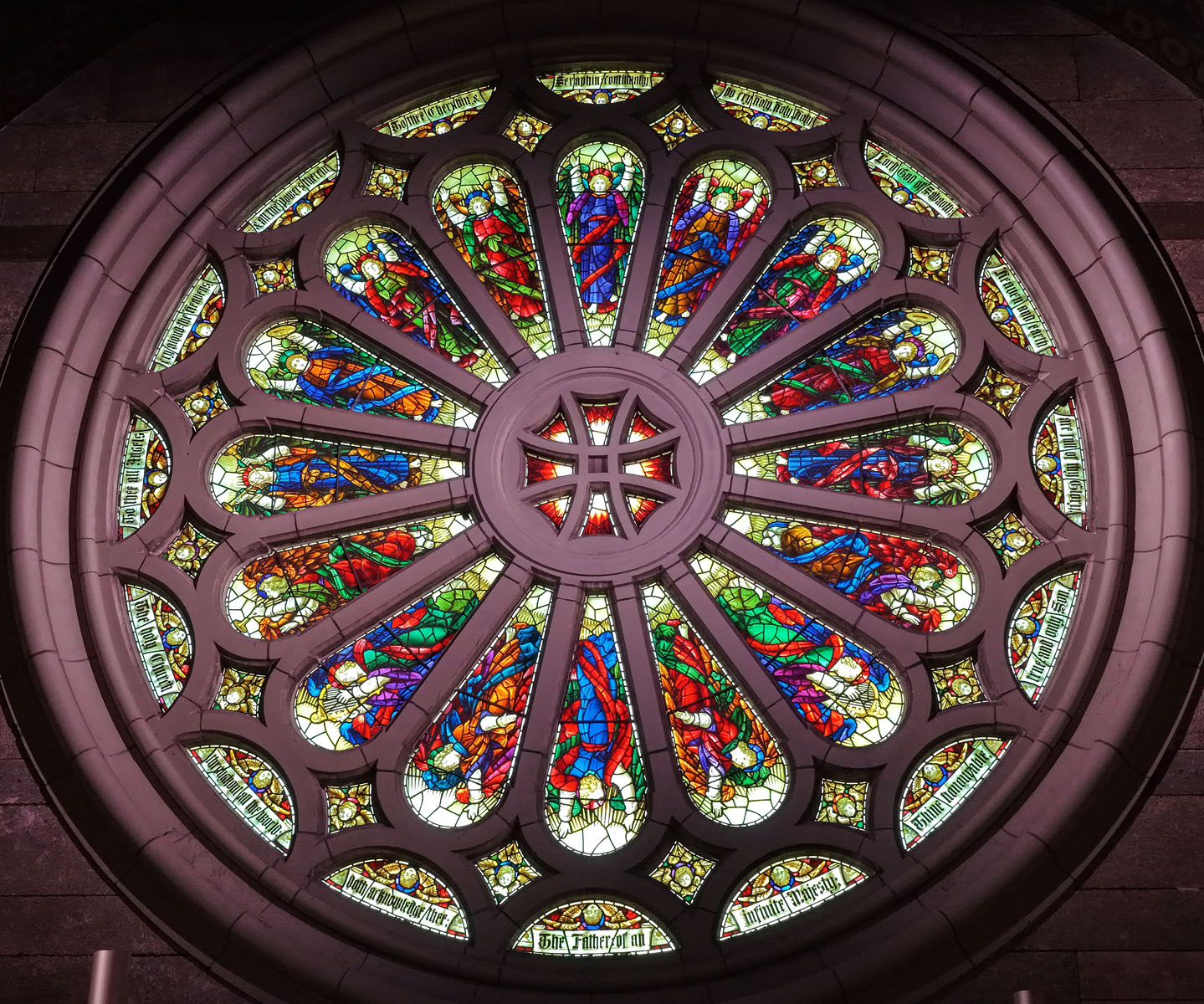
Rose window.
All photos in this section courtesy of Fountain Street Church UON.
Use the mouse wheel to zoom in and click/drag to explore the window.
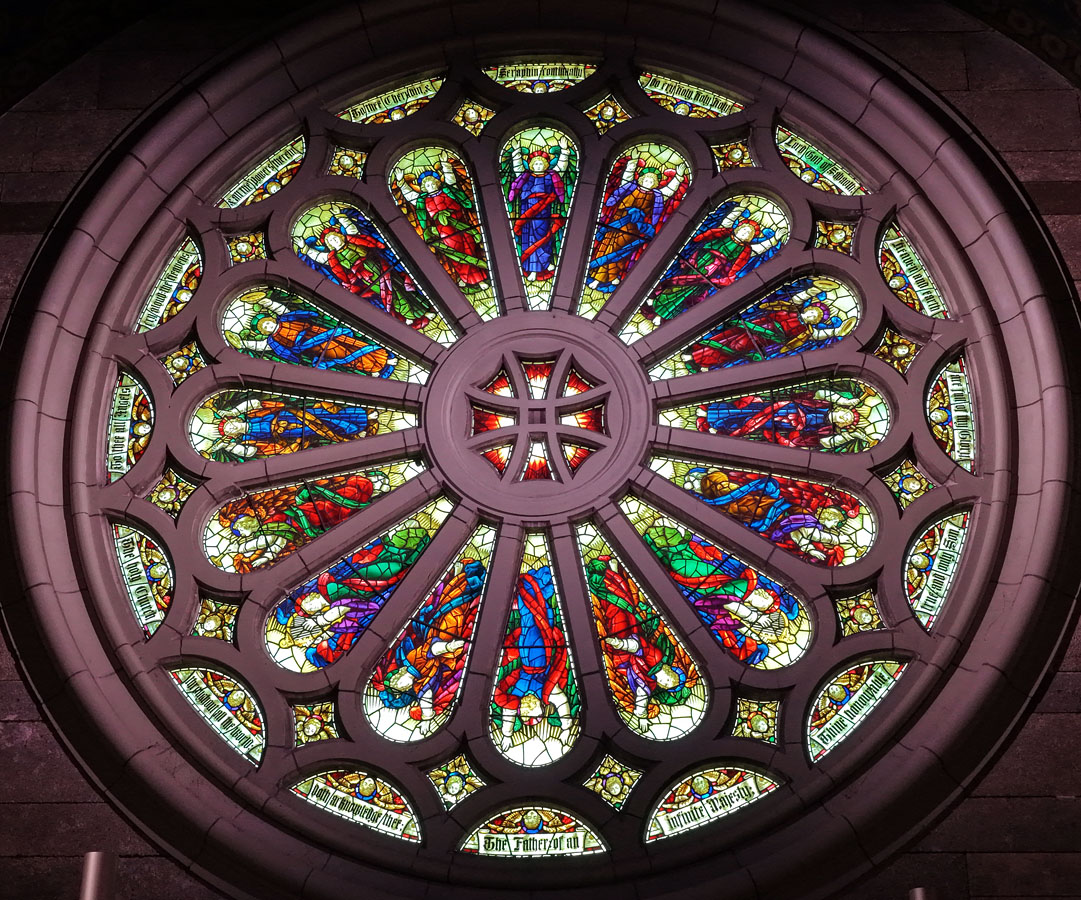
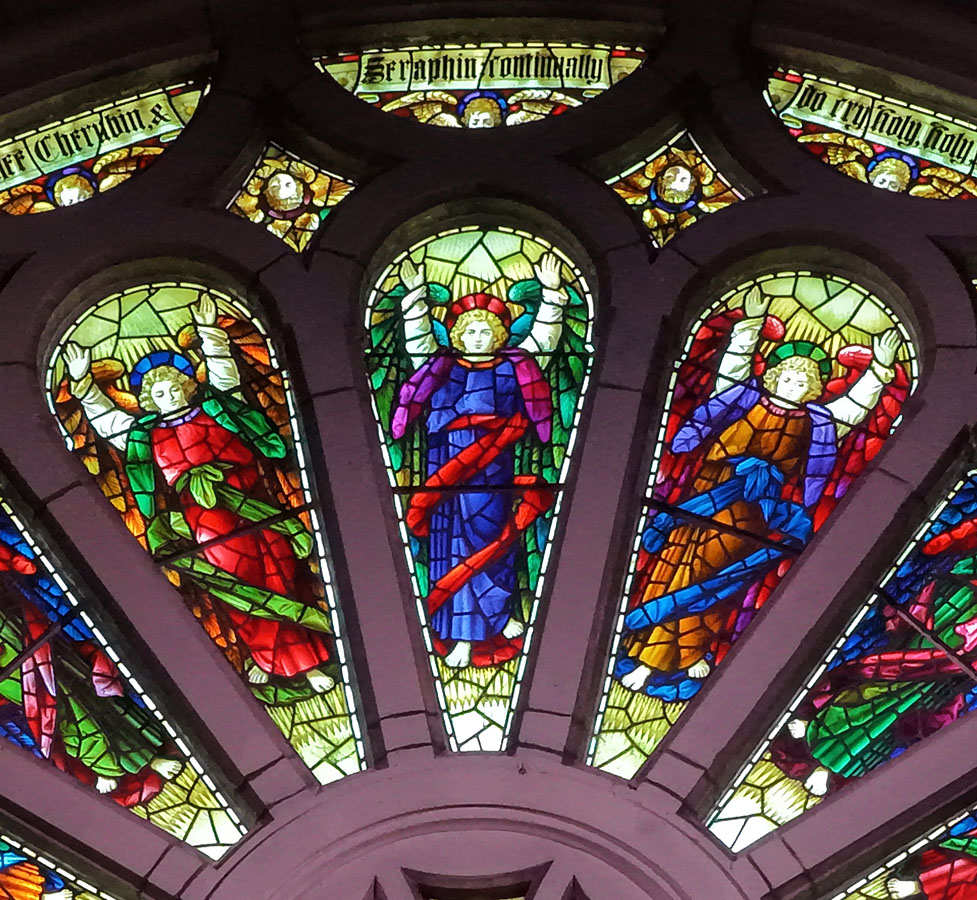
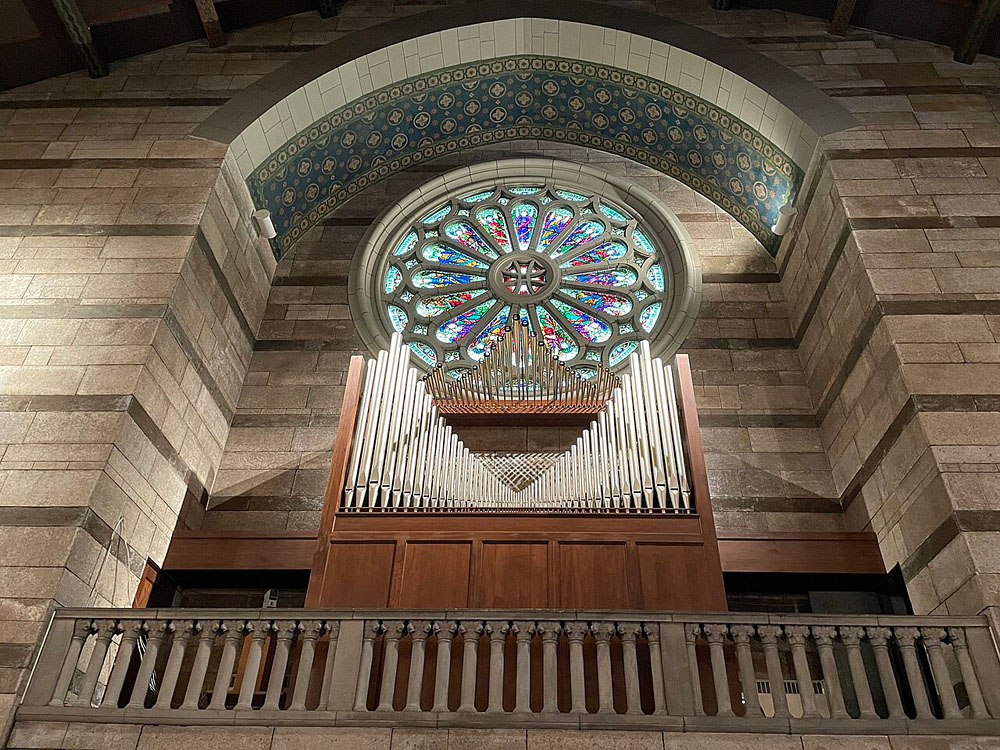
Rose Window: Te Deum. 1922.
Posted 23 May 2026.
This entry has been made possible by the kind assistance and generosity of Fountain Street Church, Grand Rapids, MI.
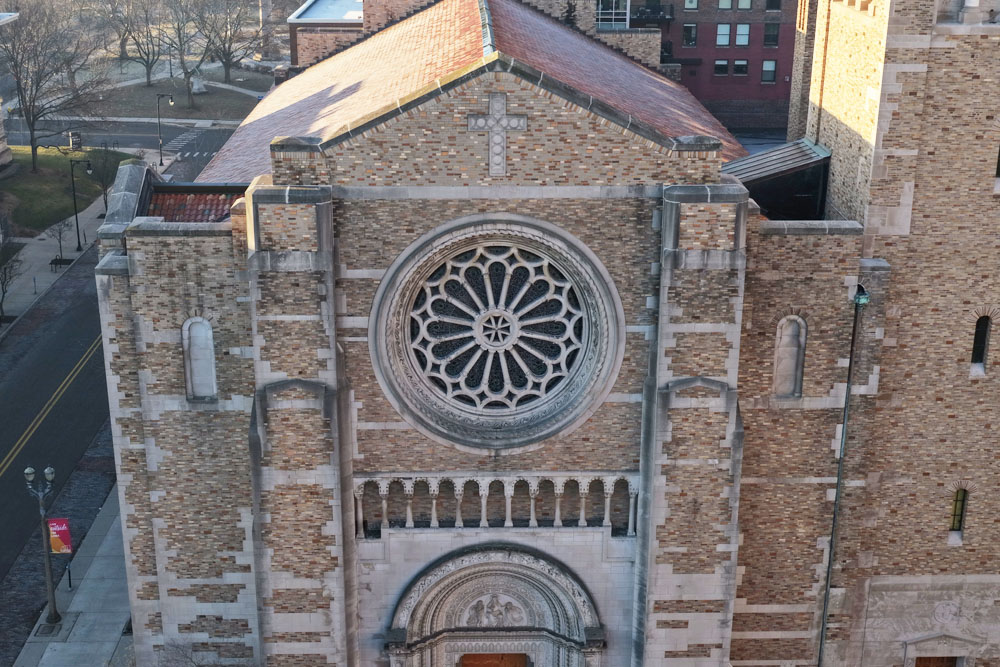
The stained glass by Percy Bacon in the magnificent rose window in the north wall of the church appears to have been commissioned and installed as part of the initial build of the new Fountain Street Church (see below for a short history). The window - a simple stylised wheel, but nonetheless bold in scale and execution - consists of a central ring boss from which spring sixteen unadorned spokes, joined together at their heads with a segmental arch to form the main lights. These head arches are supported by a similar number of slightly longer segmental arches which transfer the load to the outer rim of the wheel (in fact, the spoke head arches and "transfer arches" are singular pieces, each being carved from a single block, joined to the outer rim with an interlocking Y-piece). This arrangement creates sixteen rhombuses with inwardly curved sides, centred on the spokes, and sixteen minor segments at the outer rim, the former being filled with the heads of cherubim, and the latter scrolls with the words from the Te Deum and more cherubim beneath.
Each of the main lights is filled with the standing figure of a golden-haired angel. In the top five, and three bottom lights they sing with arms aloft or outwards in open gesture (the latter in the two lights either side of bottom-most), while in all the other lights they play musical instruments (trumpets, harps, and cymbals). Their robes are brightly coloured and each wears an enveloping, flowing sash. In all, over 5,200 individual pieces of glass make up the window, and it is therefore not surprising that the window cost and extraordinary $3,000, equivalent to over $59,000 today (2026) or about £13,000 at the exchange rate in 1922. The window was donated by Mrs F. Stuart Foote (Florence Edna Foote) in memory of her mother, Ellen Insley Zorns.1 Mrs Foote's husband, Frank Stuart Foote was president of the Imperial Furniture Company of Grand Rapids.2
The other windows in the church, modelled on some in Chartres Cathedral, were installed by Paris and Wiley.3
A little History of Fountain Street Church
PD Image.

Fountain Street Baptist Church c1880. PD Image.
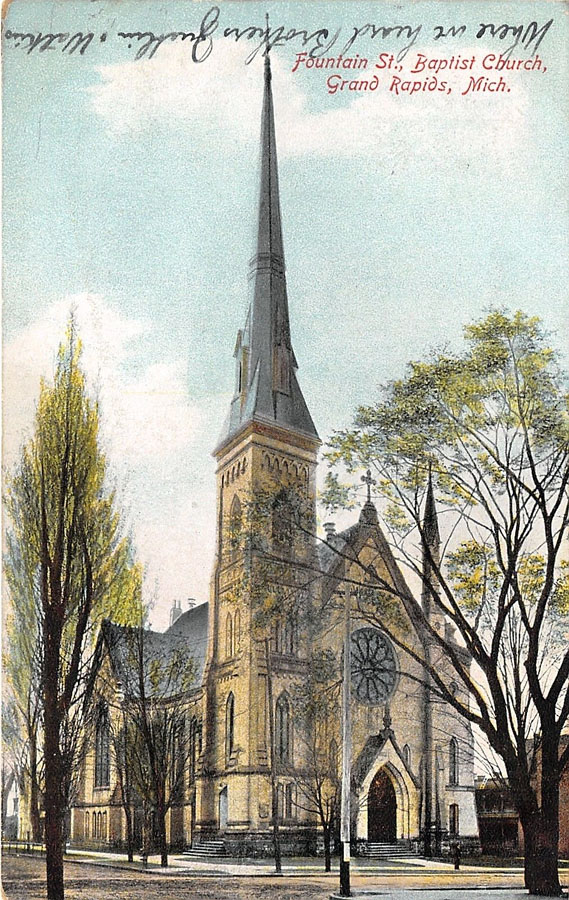
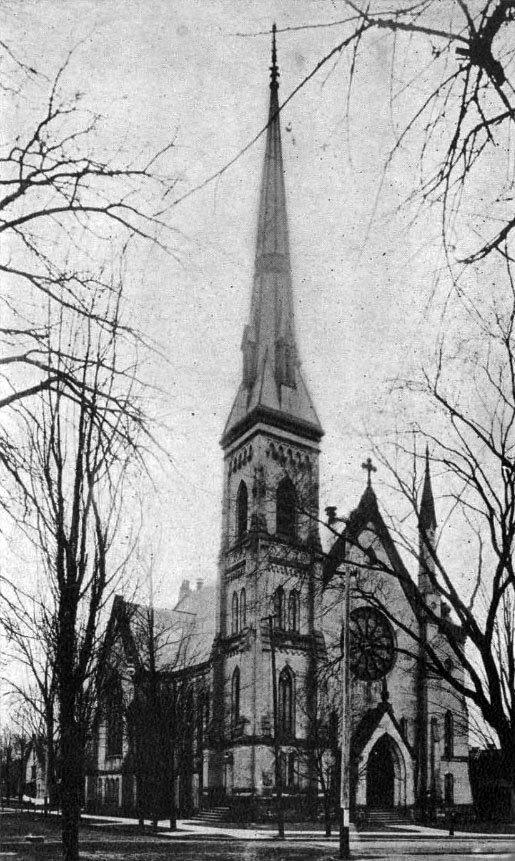
As early as 1822 there was a Baptist mission among the Ottawa tribe of Native Americans, in the Grand Rapids area of Michigan which became known as Thomas Station after one of the early English Baptist missionaries to India. In 1837 the first Baptist church was organised in Grand Rapids, although a fixed place of worship seems for many years to have been lacking. A reading of the history of the Baptist Church in the city paints a picture of disorganisation, disintegration, rebirth, reorganisation and renewal over a number of cycles.4 Until 1869 there were two churches, but the congregations were united in that year as the "Baptist Church of the City of Grand Rapids". The united church chose the site of the earlier 1860 church, a brick structure on the corner of Fountain Street and Bostwick Avenue, and in 1873 a grand gothic church was built (dedicated 1877) to designs by Gurdon P. Randall.Fn1 Orientated north-south with the entrance at the north, the church was essentially a single rectangular hall with two short east and west transepts towards the southern end. A square tower stood at the north east corner, topped with a very tall and slender spire, pierced by lucarnes in its lower stage. In the north wall was a large rose window, and along the east and west walls two tiers of two-light windows, the taller ones in the upper tier illuminating a serpentine seating gallery which extended continuously around the east, north, and west of the interior. At the south end of the sanctuary behind the podium was a large organ.5
In 1890, under the ministry of the Rev. John L. Jackson, the church began to turn away from the early Baptist orthodoxy in favour of a more liberal religion. Soon it had ceased to cooperate with the Baptist association,6 and to this day the church is unaffiliated with any denomination.
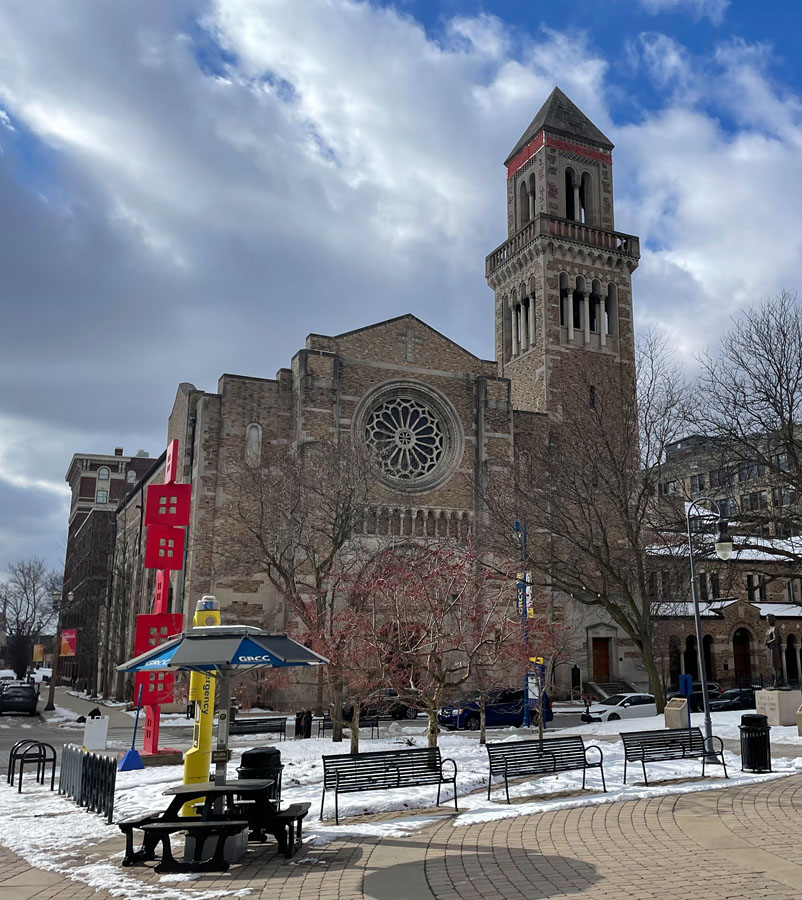
When the church burned down on 22 May 1917, it was reported that, "Thousands watched the steeple crash to the ground".7 The church's utter destruction presented an opportunity to the Pastor, Alfred Wishart who was influenced by the churches of Europe while he was serving with the YMCA in France during World War I. He believed, "... in beautiful architecture as a cultural force",8 and after seven years the grand Italian-Romanesque building we see today rose from the ashes. The architects, Coolidge and Hodgson of Chicago designed a grand Italian Romanesque building, substantially proportioned, built of light-brown, grey and buff brick and stone. It consists of a large sanctuary, arcades, and campanile. Much architectural attention was given to the northern facade which faces Fountain Street. Here there is a large, centrally placed portal with finely sculpted nook shafts, and a tympanum with a bas relief of Jesus blessing children. Above that, and separated by a blind arcade is the 26ft (7.8m) diameter rose window.
References: Use your browser's Back button to return to text.
- Letter from Owen-Ames-Kimball Company to the Building Committee dated 19 December 1922 in the church archives.
- Obituary to F. S. Foote. New York Times, 9 July 1954, p17.
- Letter from Owen-Ames-Kimball Company to the Building Committee dated 19 December 1922 in the church archives..
- Fisher, Ernest B: Grand Rapids and Kent County, Michigan : historical account of their progress from first settlement to the present time. 1918. p368.
- There is a photograph of the church interior shortly after its construction in Dilley, T. R. Grand Rapids in Stereographs, p63. Available at the Internet Archive.
- Lydens, Z. Z. (ed). The Story of Grand Rapids. 1966. p446.
- Lydens, Z. Z. (ed). A Look at Early Grand Rapids. 1976. p161.
- Carmody, J. M. Michigan. 1946, p312.
Footnotes: Use your browser's Back button to return to text.
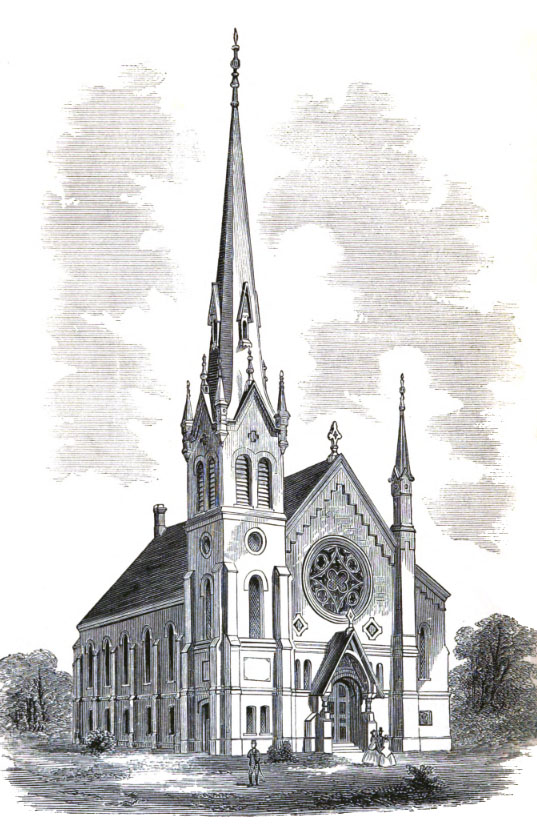
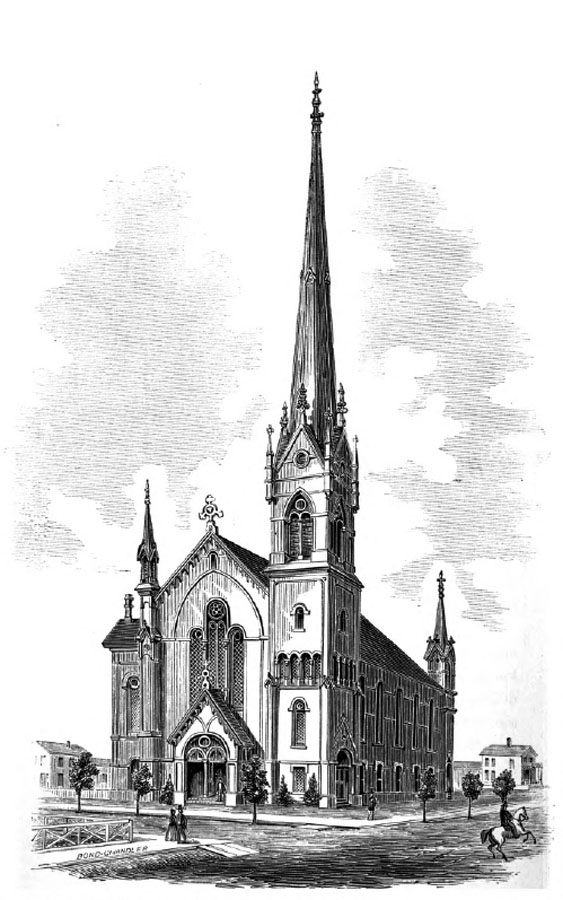
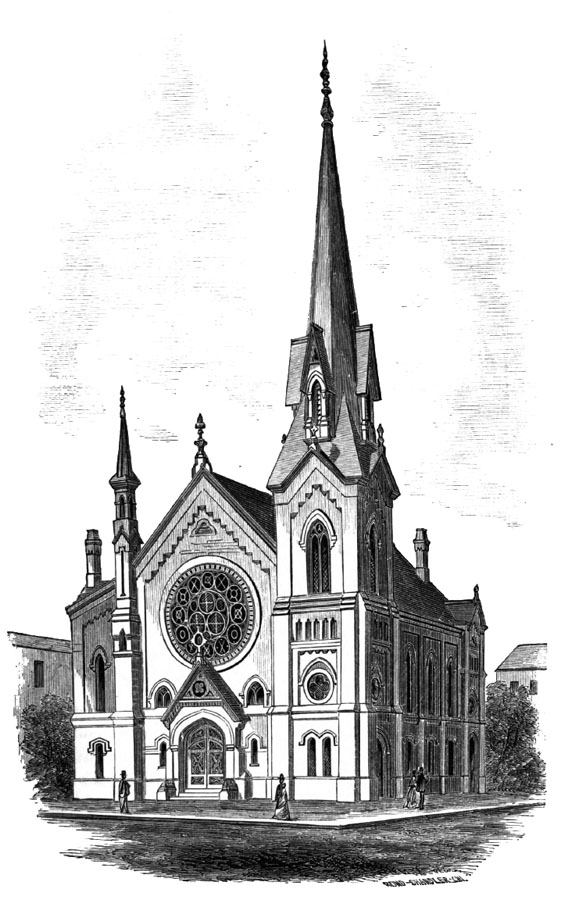
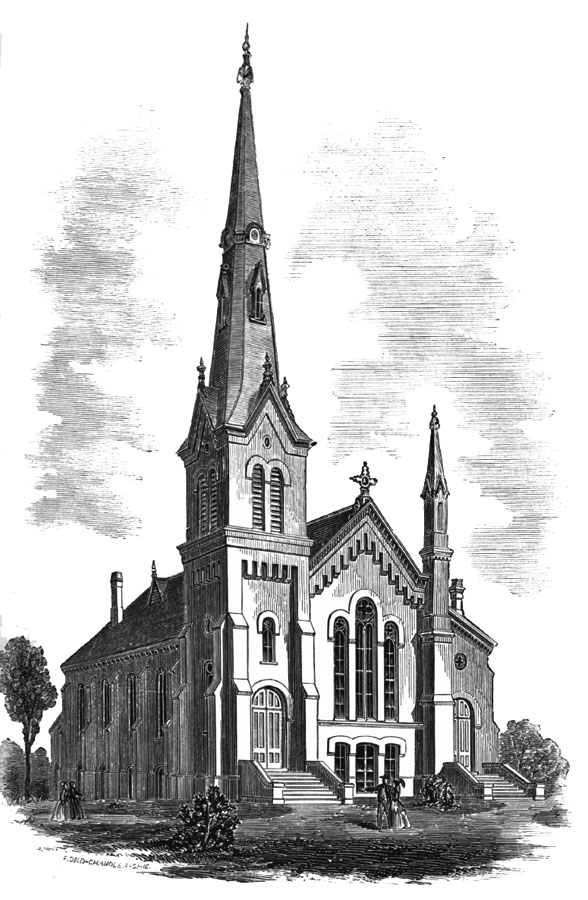
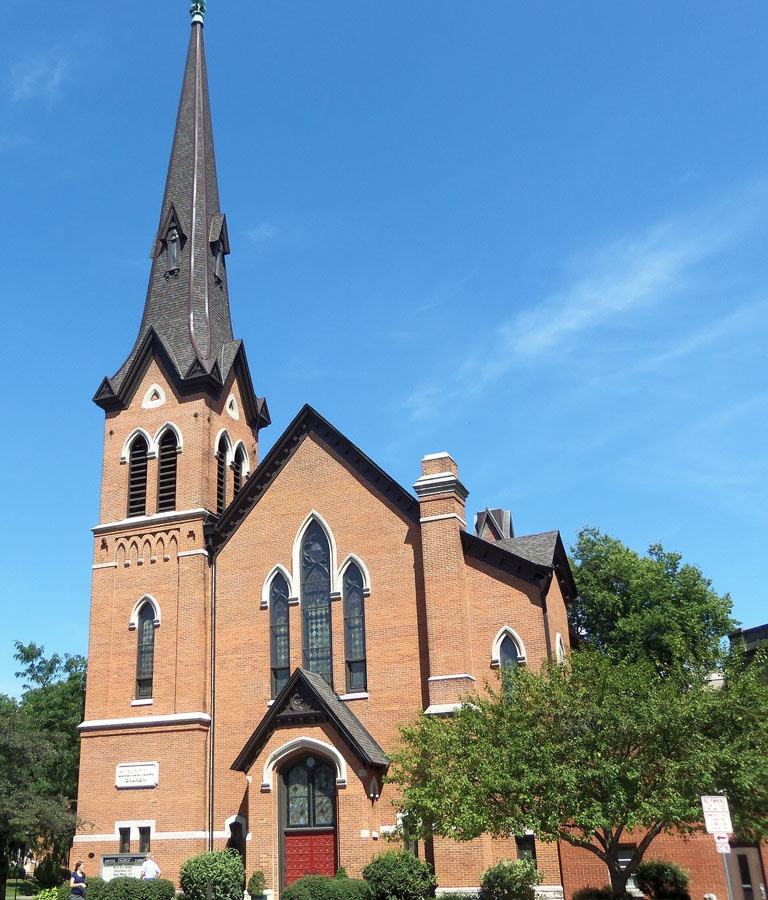
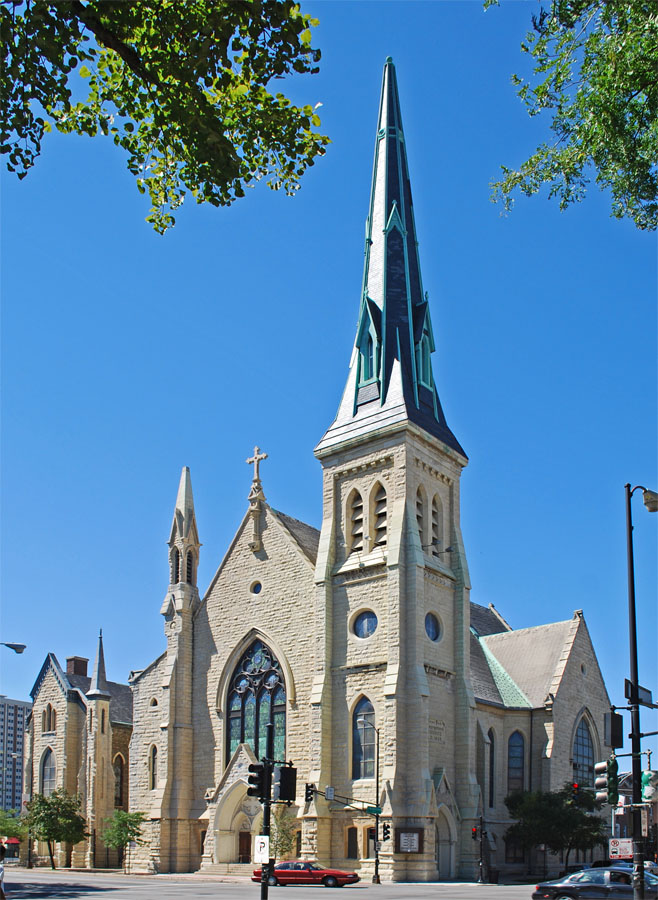
- Gurdon Paine Randall's designs for city churches showed a somewhat cookie-cutter approach which is exemplified by the Fountain Street Baptist Church of 1873. They were exclusively Gothic Revival, often being arranged as a single rectangular box with entrance centred on one of the shorter elevations over which there would be a series of tall lancets or rose window, and a square tower with spire at one of the corners. Opposite the main tower, and on the other side of the portico there would likely be a smaller subsidiary spire. The larger churches would have two tiers of windows down each side, the upper tier presumably to light a seating gallery similar to that at the earlier Fountain Street Baptist Church. Many examples of Randall's churches are still in existence today. Click
here to start a slide show of some of Randall#s work.
First Congregational Church, La Crosse, WI. Architect. G. P. Randall.
PD Image.
Location Map:
Zip Code: MI 49503