Stained Glass of Percy Bacon & Brothers
- Home
- Life
- UK County List
- Bedfordshire
- Berkshire
- Bristol
- Buckinghamshire
- Cambridgeshire
- Cornwall
- Cumbria
- Derbyshire
- Devon
- Dorset
- Dumfries & Galloway
- Durham
- East Sussex
- Essex
- Gloucestershire
- Gtr Manchester
- Hampshire
- Herefordshire
- Hertfordshire
- Kent
- Leicestershire
- Lincolnshire
- Gtr London
- Barnes:
St Michael - Camden:
St James † - City: St Dunstan-in-the-West
- Clapton,
Christ Church† - Croydon: Woodcote
- Ealing:
Christ Church† - Ealing: St Saviour†
- Hammersmith
St Paul - Hornchurch
- Little Ilford
- Islington, St Paul†
- Kensington:
St John the Baptist - Mortlake:
St Mary Mag, RC - Perry Hill,
St George† - Roehampton
- Romford, St Edward the Confessor
- Staines
- Twickenham,
St Stephen - Upminster,
St Laurence - Upton Cross,
St Peter† - Woolwich Garrison†
- Woolwich:
St Michael - Yiewsley
- Barnes:
- Midlothian
- Merseyside
- Norfolk
- North Yorkshire
- Northamptonshire
- Northern Ireland
- Northumberland
- Nottinghamshire
- Oxfordshire
- Pembrokeshire
- Rutland
- South Yorkshire
- Somerset
- Suffolk
- Surrey
- Tyne & Wear
- Warwickshire
- West Sussex
- Wiltshire
- Worcestershire
- Non UK
- Gazetteer
- Contact
- Essays
- Lost Work
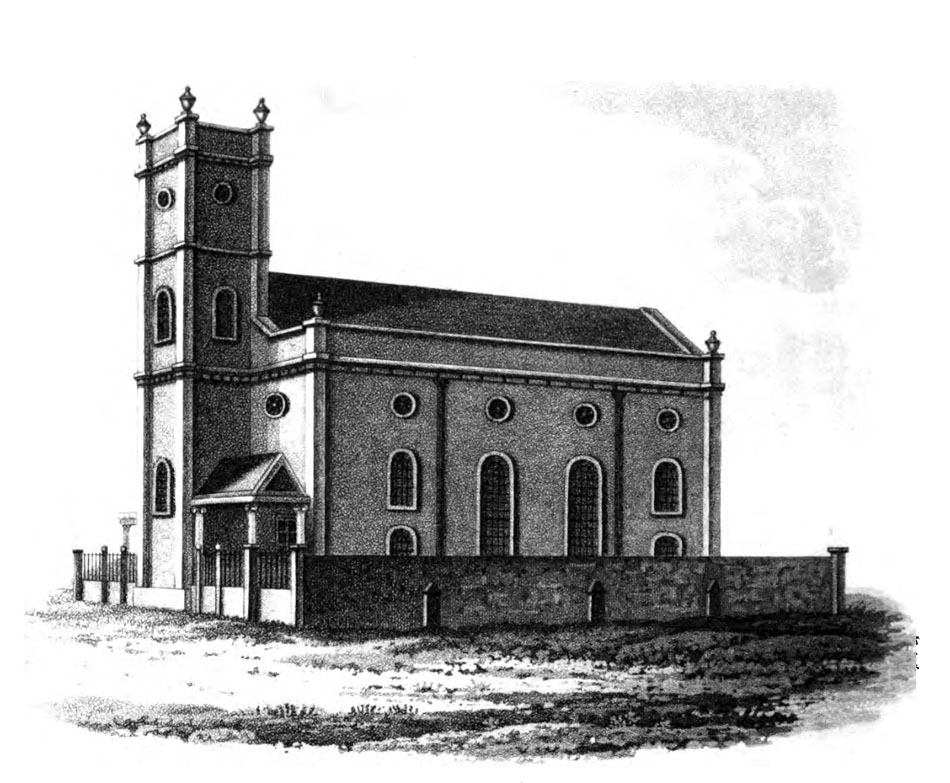

St John's Church, Sunderland, c1819.
Posted 02 May 2026.
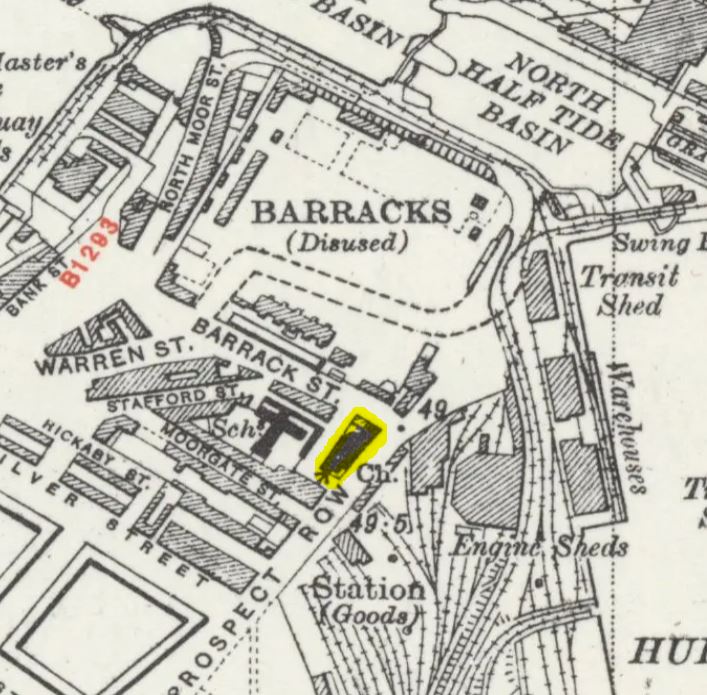
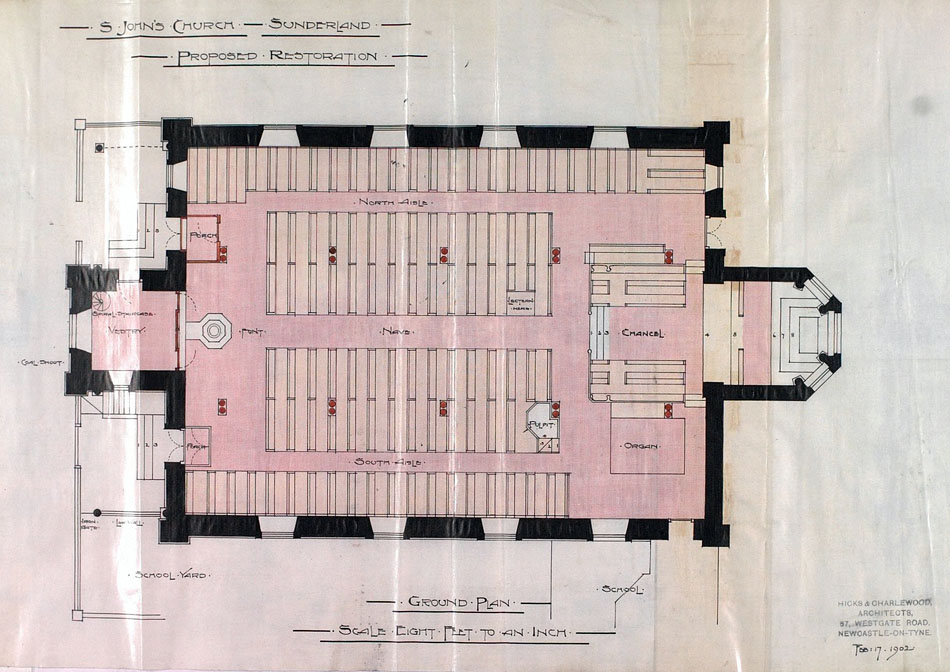
With the growth of Sunderland in the latter half of the 18th century, the parish church of Holy Trinity was becoming increasingly crowded. With the need for additional seating pressing a new church was required. St John's was built on the corner of Prospect Row and Barrack Street in 1769 1 (consecrated 6th April 2) as a chapel of ease for Holy Trinity. It was a simple building built in the English Baroque style of the time, and had seating for 1200 souls.3 The main benefactor was John Thornhill, a wealthy local business owner. The church also acted as a garrison church serving the nearby barracks. The church soon became an important asset for the poor in the area, which, in 1875, became a parish in its own right.4 The church was restored In 1901, by Hicks & Charlewood of Newcastle-upon-Tyne for whom Percy Bacon received a number of commissions in the north east of England, notably at St Chad's, Bensham. The church was demolished in 1972, with the site now occupied by modern housing.
The Sunderland Daily Echo and Shipping Gazette reported the installation of the Percy Bacon window thus:
References: Use your browser's Back button to return to text.
- Surtees, R. The history and antiquities of the County Palatine of Durham, 1908. p3.
- Smith, G. et al. Dictionary of national biography. Vol XVIII; Entry for Shield, William (composer). p105.
- Seagull City. Sunderland’s literary and cultural heritage.
- Sunderland Heritage Trails. Location 10.
- Sunderland Daily Echo and Shipping Gazette, Monday 28 October 1901, p3.
Location Map:
The church (highlighted) was demolished in 1972. The area is now occupied by modern housing.
Map reproduced with permission of the National Library of Scotland, CC-BY (NLS) license.