Posted 29 August 2025.
Driving between Kineton and Gaydon in Warwickshire, it would be all too easy to miss All Saints, and not impossible that Chadshunt itself would not be deserving of one's attention. Chadshunt, after all, consists of a couple of farms, a few houses and The Hall, the latter being difficult to see from the road. The whole village can be traversed by car in just a few seconds. All Saints is set back from the road on the higher ground in a roughly circular church yard, and is well screened by mature trees. The church is now in the care of the Churches Conservation Trust.
Chadshunt appears in the Domesday Book of 1086 under the name Cedelshvnte where the lands are listed as belonging to the Priory in Coventry:
"The Church holds Cedeleshvnte. There are 5 hides. The arable employs 16 ploughs, 2 are in the demesne, and 6 bondmen. There are 18 villeins and 12 borders, with 8 ploughs. There are 12 acres of meadow. In King Edward's time it was worth 6 pounds and afterwards 3 pounds now 7 pounds."
The entry fails to mention a church, but it is probably that one was in existence at or before the time the book was compiled, and possibly as early as the 8th century.

All Saints Church, Chadshunt, Warwickshire.
All Saints Church, Chadshunt, Warwickshire.
The church we see today is a mish-mash of different periods. The bulk of the nave is 12th century with later additions. The top embattled section of tower was added in the 17th century, though the lower part may be c15 while the chancel - an English Baroque style box - and the north transept were built in the first half of the 18th century by Ann widow of the local Lord of the Manor, John Newsham. It is the north transept that holds the object of this article; three windows installed in the 19th century by the daughters of Robert Knight (1768 - 1855), the illegitimate son of the 1st Earl of Catherlough, also called Robert Knight; the 1st Earl's legitimate son, Henry Knight had died in 1762 without issue. In 1772, the 1st Earl of Catherlough had been in negotiation to buy the estate at Chadshunt, but he died before the transaction could be completed. His will, however, instructed his executors to complete the purchase and they duly did so, his surviving son inheriting the estate.
Quite how the stained glass panels came into Robert Knight's possession is not known, but it is recorded that they came from a convent in Italy, and had first graced his town house in Governor Square, London prior to their translation to Chadshunt. Given the date "1856" inscribed on the transept east window, it is probable that the panels were installed by members of Robert's family. The initials "FEK" at the base of the west window, representing Frances Elizabeth Knight. Robert in his will of December 1854 stated his wish to be buried in the vault under the family pews in the north transept.
Back to top
The 16th century panels, four in each window, depict scenes from the Old and New Testaments, and have been inset into modern glass. The glazier is unknown. The top panel of the north window has the arms of Knight; argent three bendlets gules, on a canton azure a spur or. The date of the original works seems to be confirmed by the date 1558 on the second panel from the top in the east window. H. T. Kirby, of Gaydon, one-time editor of the Journal of the British Society of Master Glass Painters, writing in 1943 suggests that the panels were painted by at least three different artists as they vary in style and accomplishment.1 The church guide published by the Redundant Churches Fund prior to 1994 when the organisation changed its name to the Churches Conservation Trust, suggests that the lower two panels in the east window are copies of the originals which were destroyed by vandals.2 However, as a date for the destruction is not given it is not certain whether Mr Kirby was writing before or after that event. If it is the case that these panels ar replicas, the unnamed modern artist has done an astonishing job! Kirby also suggests that these panels may be from a wider sequence forming a much more comprehensive scheme.
Click on the images below to start a slide show with detailed descriptions of each panel.

North Transept East Panel 1.
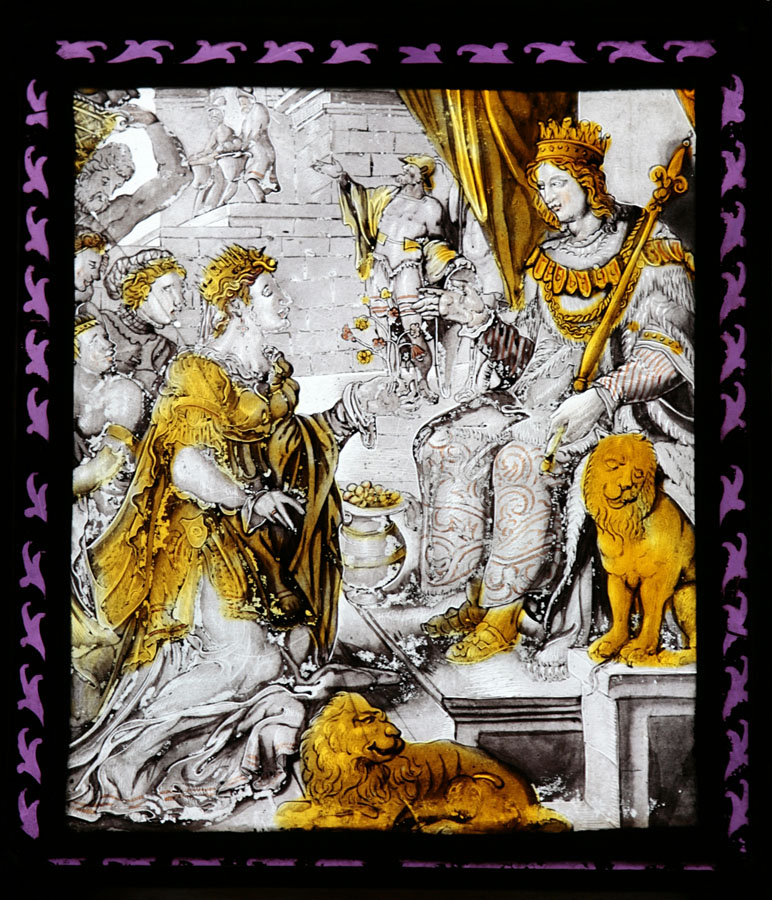
The Visit of the Queen of Sheba: A rather feminine looking King Solomon sits on his throne, sceptre in hand. Beside him sits a small lion, and another one rests at his foot. It is not clear whether these are real or statues. The Queen of Sheba, finely dressed in a gold surcoat, kneels before Solomon offering him a posy of flowers, while behind her her retinue look on. Also behind Sheba can be seen a man carrying a heavy jug on his shoulders, presumably full of wine; a gift to Solomon. In the background a soldier directs other men carrying more gifts into the palace.
North Transept East Window.
North Transept East Panel 2.
Unidentified Scene:
Although this scene has not been categorically identified, H. T. Kirby tentatively suggested it may represent the Wisdom of David and Solomon. It is, however, an important panel as it provides a date, 1558. The panel depicts two Kings seated either side of two characters; one holds what appears to be a musical instrument and scales (of justice?), the other an open book, with either a musical score or just text. The king to the left holds an orb, while the one to the right holds a sceptre.
North Transept East Panel 3.
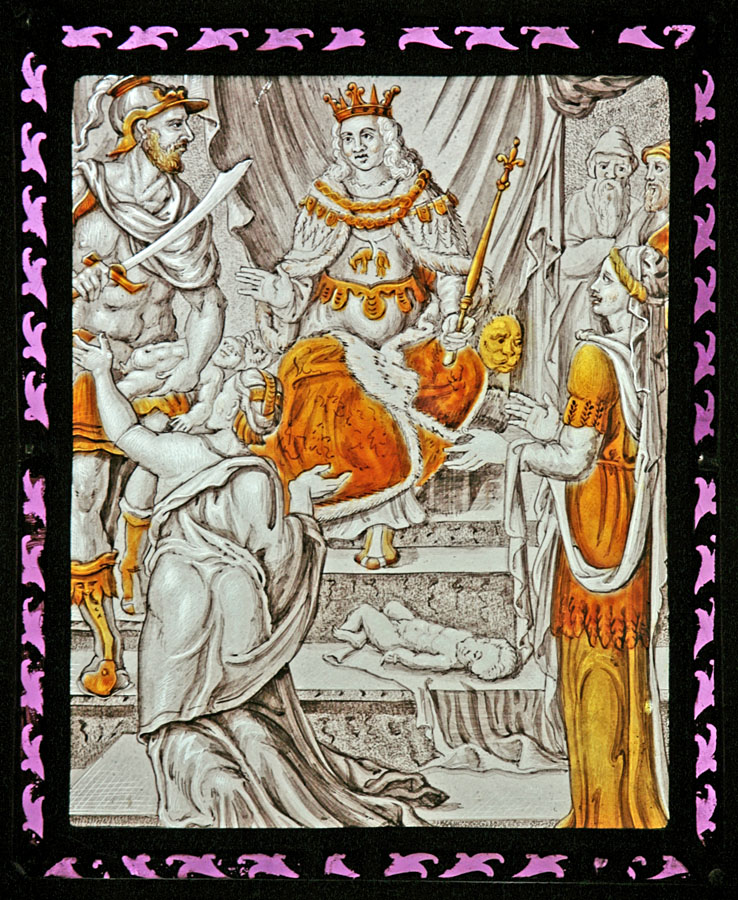
The Judgment of Solomon:
This panel depicts King Solomon on his throne, sceptred and dressed in ermine robes with the Catholic Order of the Golden Fleece around his neck. This popular subject from the Old Testament (1 Kings 3:16-28) in which King Solomon demonstrates his God-given wisdom by devising a way to determine which of two women was the true mother of a living child. The two women stand before Solomon, while the baby which had died lies on a step at his feet. To Solomon's right stands the soldier, scimitar in hand, with the living baby across his knee. He is ready to cut the baby in half as Solomon commanded. On the left of the panel the true mother kneels, her arms raised in alarm at the imminent demise of her child, and clearly begging for the baby's life. In the background stand two men, witnesses to the scene, possibly representing those who went on to record the encounter. A pre 1994 church guide suggests that this panel was destroyed by vandals and that this is a copy of the original.
North Transept East Panel 4.
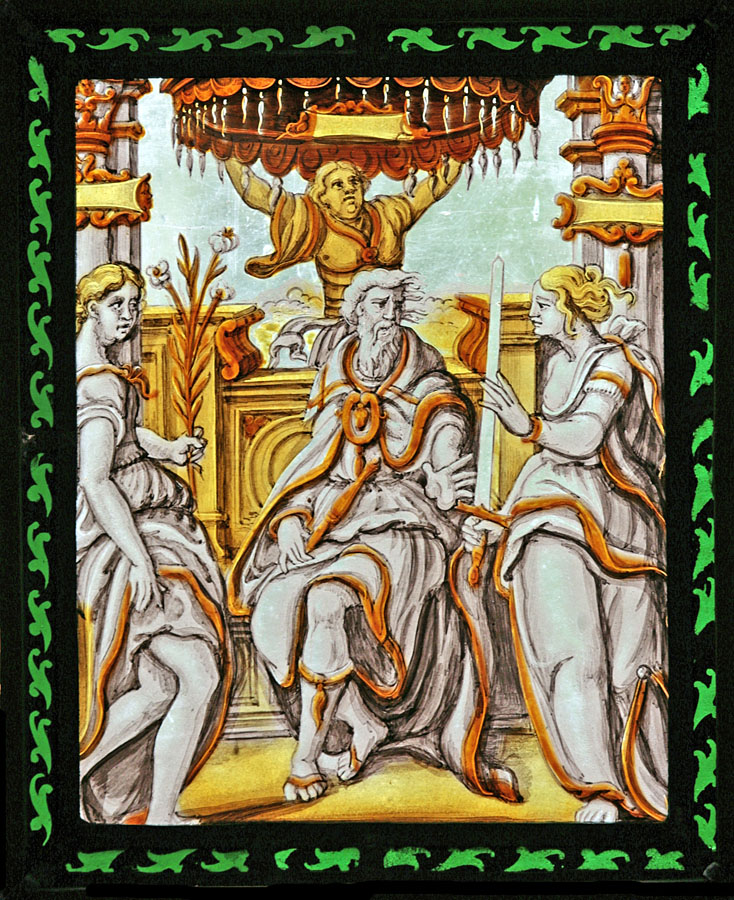
Jephthah and his Daughter:
This panel is somewhat of a puzzle. H. T. Kirby hazards a guess that it depicts the moment that Jephthah has to kill his daughter. Following Jephthah's victory over the Ammonites, a story related in Judges 11, he vowed that the first thing which came out of his house would be sacrificed to God as a burnt offering. It was his daughter who was first to come out to meet him. On the right of the panel a woman stands with a sword in hand which she appears to be about to give to the seated Jephthah, her left hand seemingly checking the sharpness of the blade. One of her breasts is exposed, the significance of which is somewhat lost. On the left of the panel another woman stands holding lilies, emblematic of virginity. The figurative work on this second woman is poor as she appears somewhat anatomically distorted. The significance of the man standing behind Jephthah is not clear. A pre 1994 church guide suggests that this panel was destroyed by vandals and that this is a copy of the original.

North transept north window.The 16th century Italian panels in this window depict the following (from top left anticlockwise):
- Abraham meeting Melchizedek.
- The circumcision of Jesus.
- The Exodus from Egypt.
- The destruction of the first born.
These panels differ from those in the east and west windows. All the scenes are framed by columns and an elaborate gilded top rail sporting cherub faces or bird heads. These were clearly painted by a different hand to those in the east and west, and judging by the architectonic similarities were part of a wider sequence of panels. In the top light are the arms of Robert Knight; argent three bendlets gules, on a canton azure a spur or.
North Transept North Panel 1.
Abraham meeting Melchizedek. This panel represents Genesis 14:17-20, when, following his defeat of Kedorlaomer and the kings allied with him, Abraham is met by Melchizedek, King of Salem who gives him food and wine. Abraham is dressed in gold armour, while his victorious soldiers look on.
North Transept North Panel 2.
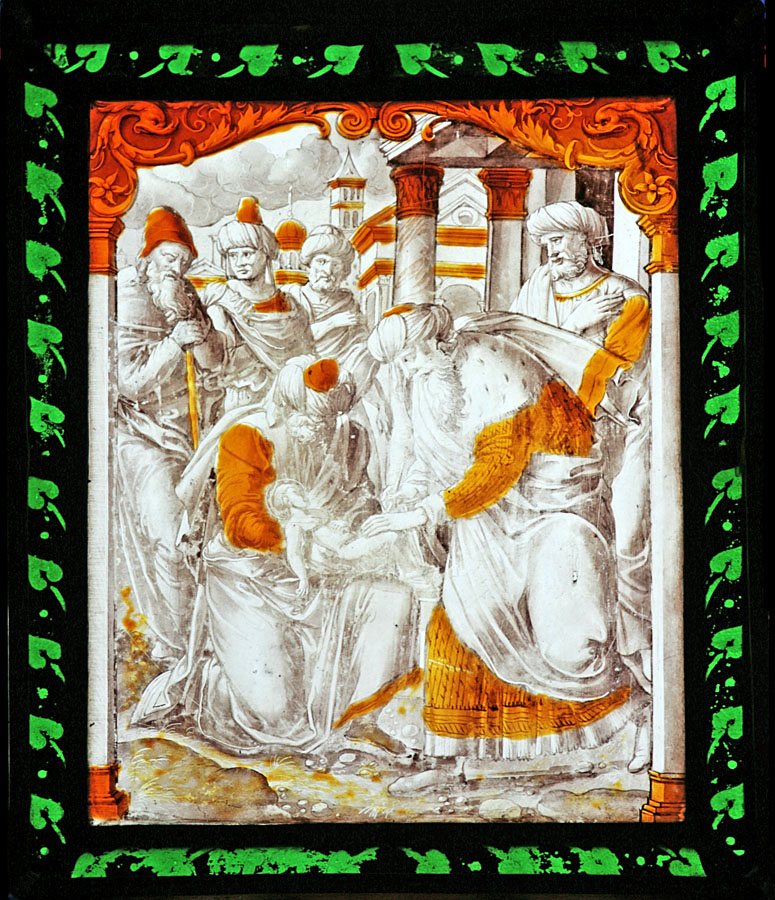
The circumcision of Jesus. An unusual subject for a church window, this panel depicts the moment the infant Jesus is ritually circumcised. The priest on the right performs the operation on the infant who is held delicately by another priest. Both priests are turbaned. In the background Joseph looks on with eyes closed, and an expression of sadness. Both the man to Joseph's left looks at him as if surprised by his demeanour. There appears to be no biblical precedent for this imagery.
North Transept North Panel 3.
The Exodus from Egypt. This panel is probably the best preserved of them all. The Israelites are led from Egypt by Moses and the mitred priest Aaron. Moses is shown striding strongly, gesturing onward. This image is iconographically interesting. A common convention in Latin Christianity was to show Moses with two horns on his head, sometimes depicted as shafts of light emanating upwards. However, in this representation, the "horns" have been reduced to what appear to be two carefully coiffured forelocks of hair crafted from his fringe.
North Transept North Panel 4.
The destruction of the first born.
North Transept North Window.

North Transept West Panel 1.
In this panel a group of men stand around a dilapidated plough, some gesturing towards it. The central character, being the only one haloed, is clearly a representation of Jesus. He also point to the plough. The panel is likely to represent the line in Luke 9:61; "But Jesus said, 'No one who puts his hand on the plow and looks back is fit for the kingdom of God!'” H. T. Kirby suggests that the clean shaven man to Jesus's left is St John.
North Transept West Panel 2.
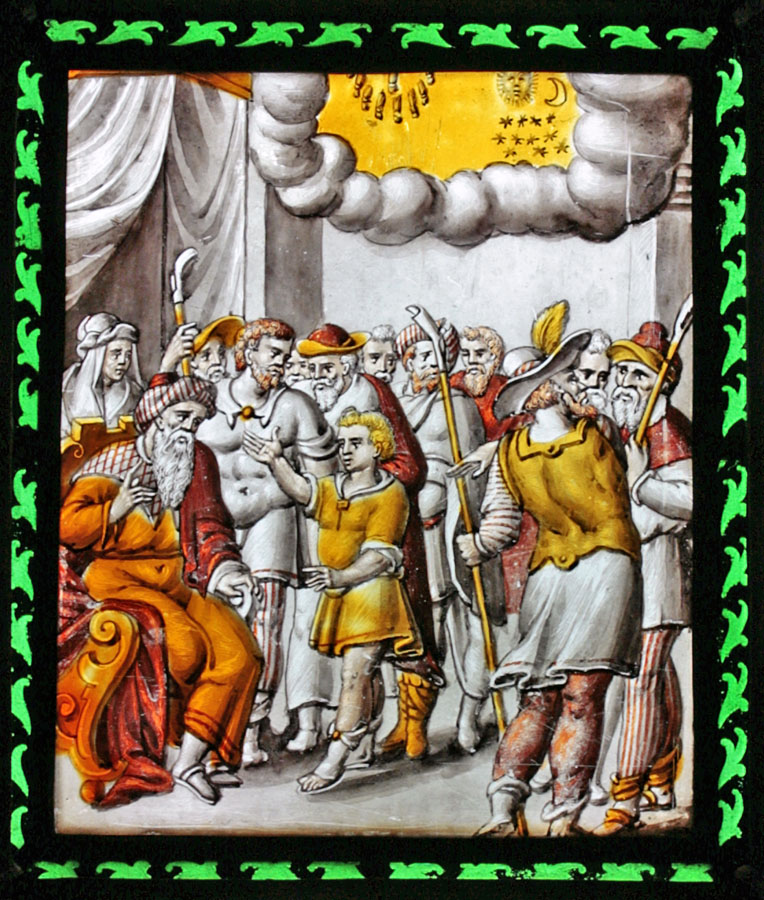
This panel forms a trio with the other two in this window. It depicts Joseph as a small but sturdy boy with golden hair recounting his dreams to Jacob who seems to be listening intently. To underline the substance of the scene, the artist has incorporated two of Joseph's dreams as insets at the top of the panel, bolstered by a cloud like motif. The pictured dreams represent (left) Genesis 37:7; "We were binding sheaves of grain out in the field when suddenly my sheaf rose and stood upright, while your sheaves gathered around mine and bowed down to it”, and Genesis 37:9 (right); "{Joseph] said, 'I had another dream, and this time the sun and moon and eleven stars were bowing down to me.'” Within the room stand a number of brothers some of whom hold unusual looking staffs, with heads not unlike hockey sticks. H. T. Kirby notes; "Red enamel—in stripes—will be noticed in various places, such as turban, hose, etc., and is a peculiar whim associated with this artist only. The work is much more pleasing than that of No. 1 above."
North Transept West Panel 3.
Here Joseph finds his brethren. Joseph is noticed as one of his brothers points towards him, while others in the background tend to their sheep. Joseph's "coat of many colours" is rendered as white and red stripes. A rather incongruous ruin is worked into the scene.
North Transept West Panel 4.
This final panel in the trio representing the story of Joseph in prison for resisting the charms of Potiphar’s wife. He is shown as a trusted gaoler evident by the open door and the keys on his belt. He stands before two seated prisoners, clearly the Chief Baker, and the Chief Butler, as is indicated in the two little insets above them. H. T. Kirby comments: "Joseph, perhaps because of his maturity, is better drawn in this than in the preceding pictures, and looks a well set-up, attractive man. Perhaps the design is the best of the series, though the dungeon cell is a little reminiscent of Italian grand opera."
North Transept West Window.
References: Use your browser's Back button to return to text.
- Kirby, H. T. Apollo Magazine (New York), September 1943, p65 etc.
- Redundant Churches Fund Guide to All Saints.